There’s a big fire in the hills to the east of us. Maybe it was started by accident. Maybe not. But still, people are losing what they may not be able to replace.
— “Parable of the Sower,” Octavia Butler
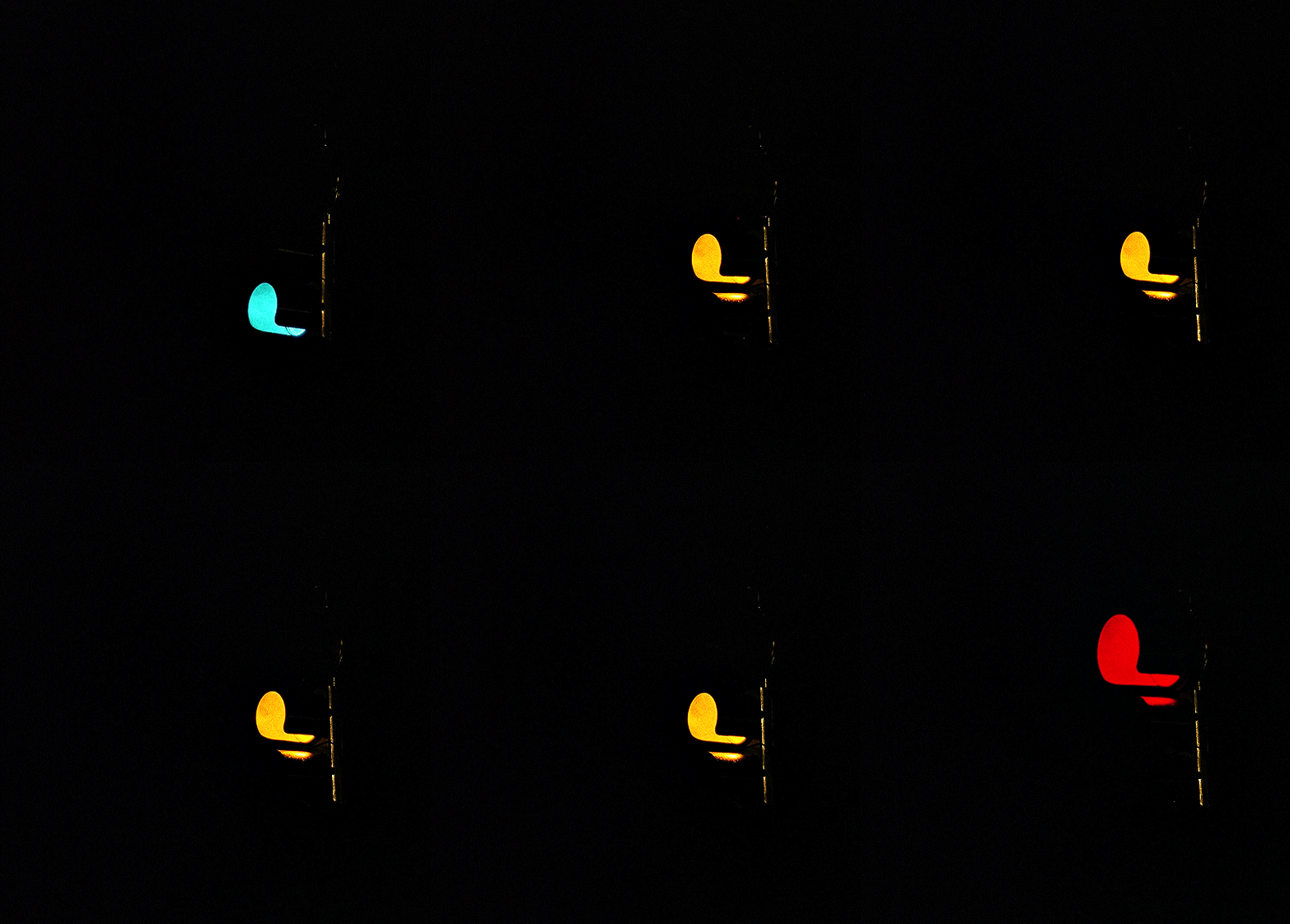
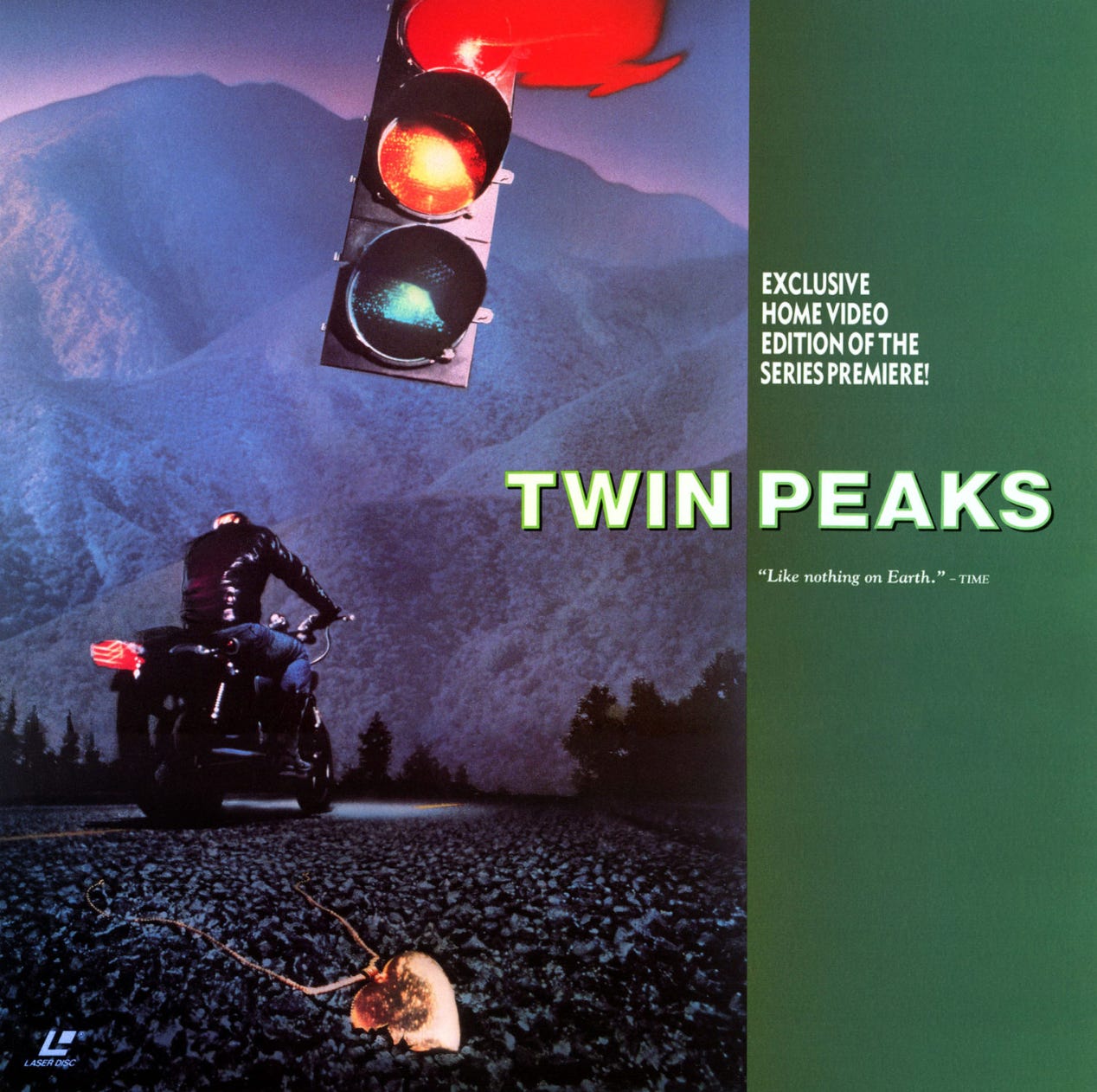
Source: Twin Peaks
🔥🔥🔥
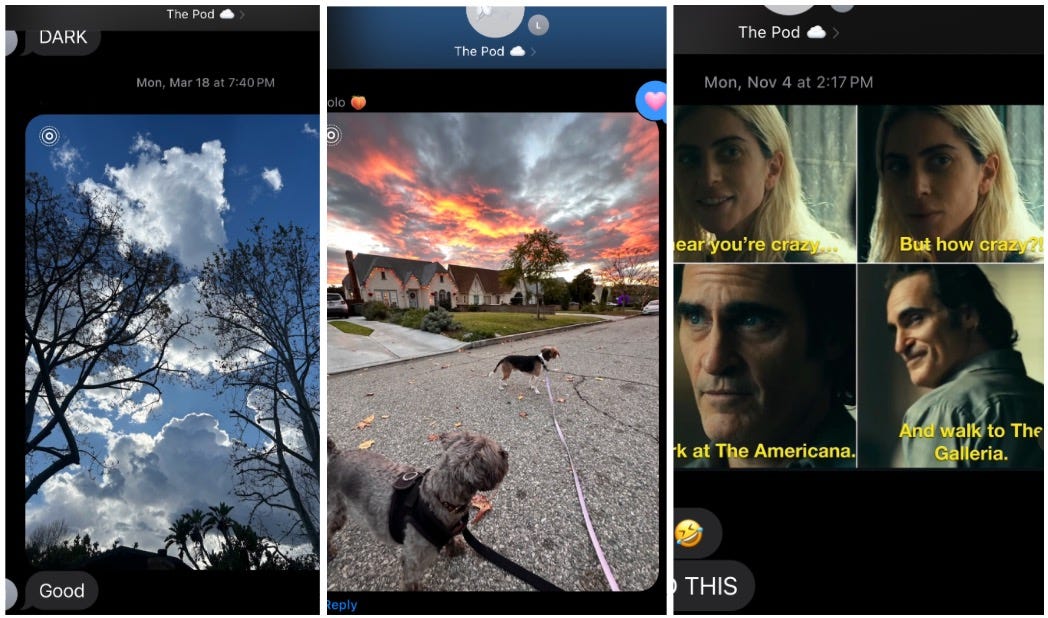
Lo and I have a group chat with our friend Margot, devoted, in large part, to screenshots from the Americana at Brand meme account and pictures of unusual clouds.
I’m not entirely comfortable admitting that the chat’s cutesy name is “The Pod ☁️,” or that wind is our acknowledged favorite element… let alone that I have a kind of personal cosmology built around its mystic qualities. Start telling people that the wind carries coded ancestral messages, and some pedant invariably says, “Sounds like you got stoned and went for a walk in the wind.
Thanks for reading! Subscribe for free to receive new posts and support my work.
Which—technically—fine. But that misses the point.
Wind charges ions and alters moods. A sound engineer’s recording of wind in a Scottish forest inspired David Lynch to imagine Twin Peaks, my favorite show. Between scenes, Lynch returns to mist-shrouded Douglas firs, the breeze stirring the canopy like breath across a curtain. To coax a more mysterious performance, Lynch would tell an actor to try the scene again “with more wind.”
🔥🔥🔥
On Tuesday, January 7, we confirm plans to convene in Altadena the next day for vision boards and New Year’s intention setting. Lo has secured glue sticks and construction paper. Margot volunteers to bring scissors and a stack of fashion magazines. A frostbitten Tri-Stater, I’m culturally conditioned to be skeptical and scoff-prone, but twenty years in Los Angeles will change a man: I propose a mid-afternoon vision boarding—my weekly Zoom breathwork meets at noon, and I’d prefer not to miss it.
The Santa Anas have been howling all week, rattling our gutters and setting off car alarms down the block. At night, our bedroom sounds like rush hour in the Lincoln Tunnel; the noise seems unhinged and improbable. Lo and I lie in bed, marveling at the roar, hoping it won’t wake the baby.While Felix dream-sucks his four-a.m. bottle, I look out across a backyard littered with fallen branches. The picnic table has been knocked onto its side and the barbecue teeters, upside down, on its rounded aluminum lid. The chaise lounges’ thick lima bean-green cushions are pressed up hard against the fence, like so many handcuffed motorists.
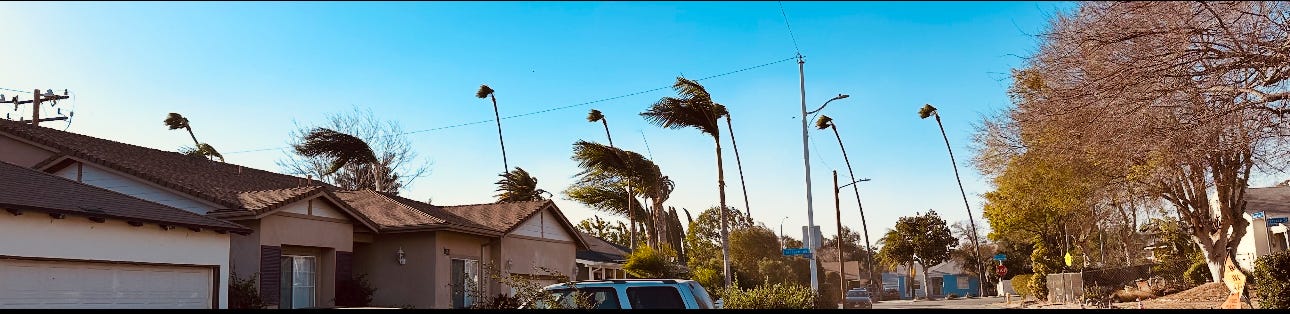
The next morning, feeling like a surfer stuck at the office during a legendary swell, I ask Lo to watch Felix so I can put my face in the wind. I walk down Glen, across Harriet, and head up Fair Oaks, past the Life Church of the Nazarene and the Cash Only dispensary with the hostile budtenders. The wind is fantastic, twisting bushes and rattling the dry pepper trees. It smells like asphalt and sagebrush and the acrid foothill dust. Cars slalom plastic trash bins that have blown into the streets; my thinning hair whorls into a wispy bouffant; Altadena’s ubiquitous inflatables—giant candy canes, jumbo Nutcracker soldiers, teams of sleigh-pulling reindeer—tip and topple, flail and flutter. The palm fronds whipped flat against the sky remind me of the Blown Away Guy in that famous Maxwell Cassette ad: his hair, his tie, even the lampshade pinned back by the force of sound.
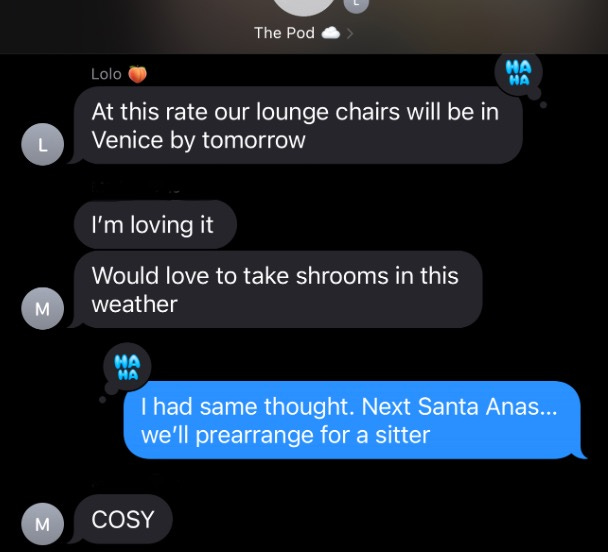
I take a picture and send it to The Pod ☁️.
The worst part of the house burning down is the irreplaceable loss and the whipsaw dislocation. But the galling irony runs a close second.
🔥🔥🔥
Back at the house, Felix bobs in the Baby Bjorn and Lo pumps in front of the local news. A fire is burning in the Pacific Palisades, spreading rapidly and zero percent contained.
A cliffside haven with sweeping Pacific views, the Palisades are the most-cited Angelino relo fantasy: “If absolutely everything broke my way, and I could live anywhere.” A world (and several tax brackets) removed from the flatlands below, its Spanish Colonials and white-brick Cape Cods are folded into the craggy Topanga bluffs like prayers in the Western Wall.
By 2pm, 700 acres are burning and thousands more are threatened. Fueled by supercharged winds, blazes race up and down slopes, devouring chaparral-covered hillsides. Evacuation is a nightmare. Fire trucks struggle to navigate steep and winding roads snarled with escaping residents. Smoldering embers whip ahead of the fire, igniting dry ground.
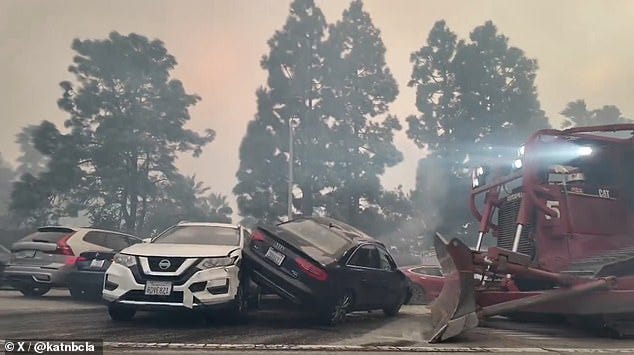
From 2500 feet, the KCAL 9 helicopter circles above Sunset Blvd, choked with honking cars. When a Mercedes G Wagon breaks down and blocks traffic, a (mostly) orderly retreat devolves into a rout. People abandon their vehicles and flee on foot. The news cameras pan across an endless vista of abandoned cars, a stock shot pulled from an alien invasion movie. To reach the fire, the LAFD uses an industrial plow to knock vehicles off the road like so many discarded toy cars.
🔥🔥🔥
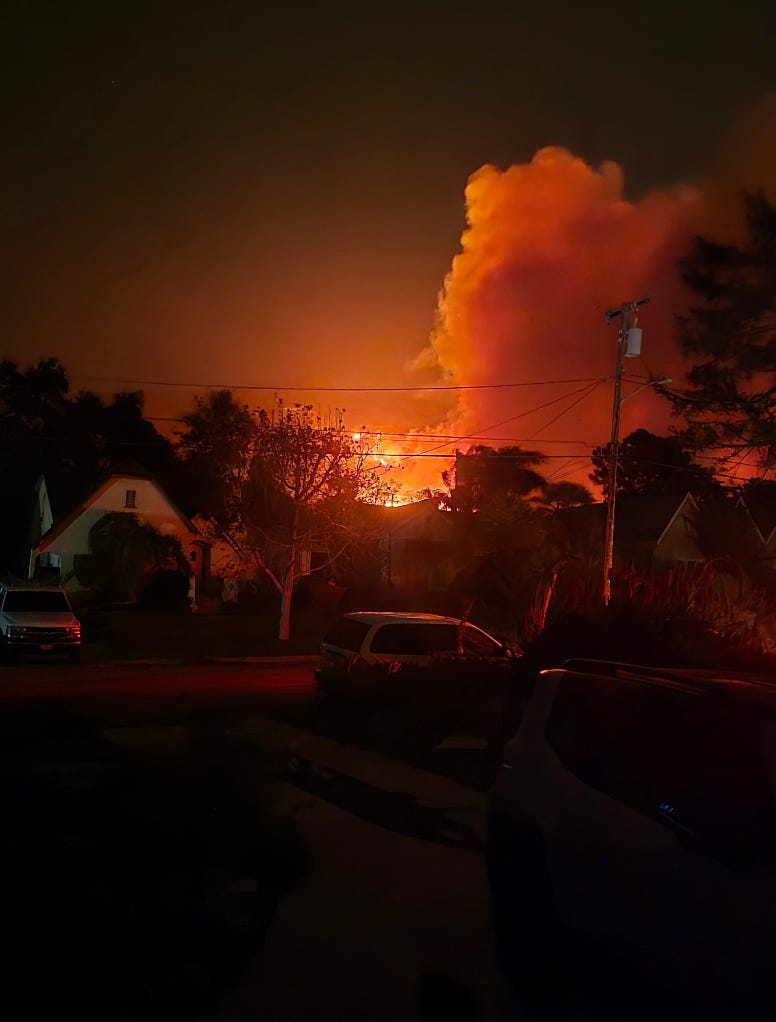
6:02 pm. The view from our front porch:
🔥🔥🔥
We’re worried about our friends up in the Palisades. But our immediate concern is losing power.
Once it became clear that inverted nipples (Lo’s) and a tight frenulum (Felix’s) made breastfeeding impossible, pumping became Lo’s full-time job, and the status of the SMR (Strategic Milk Reserve) her full-time obsession. (Yes, we believe that your Lactation Consultant is a “miracle worker.” No, we don’t need her number.)
Pump is an evocative and appropriate verb. Lo is a machine operator: flanges, valves, membranes, each with their own cleaning and assembly protocol. If she isn’t scrubbing, drying, or sanitizing pump parts, performing daily maintenance on the Baby Brezza, wriggling into her pumping bra, or scrolling Pump TikTok, then she’s screwing the pump back together to start the cycle again. The rhythmic uncha uncha of the hospital-grade Spectra is to our lives what electricity is to Eraserhead: the omnipresent underbed of the sound design. A few weeks earlier, when Manny came to meet the baby, I noticed him unconsciously bobbing his head to the phat beats of milk expression.
Pumping is labor and Lo clocks in every 4 hours. On Sunday, our dog knocks a mostly-empty bottle off the coffee table. We lose maybe 2oz and Lo literally cries over spilt milk. If the power goes and we lose a freezer’s worth of hardwon milk, Lo may full snap.
🔥🔥🔥
Altadena Hardware—a single story of weathered stucco and exposed brick—is Central Casting family-owned business: a comfortable and comforting place that has (their sign proclaims) sold “Fine Goods at a Fair Price” for 80 years. Maybe they don’t know your name, but, if you’re local, they remember your face and appreciate your business. When I was painting the nursery, they allowed me to return an opened gallon of paint without a receipt.
I park across the street, forcing the car door open against the howling wind. Inside, there’s an atmosphere of freaky holiday: crowded aisles, hushed voices. Lanterns are sold out, but I snag the final cooler. When Jim, the owner, rings me up, he asks about the nursery.
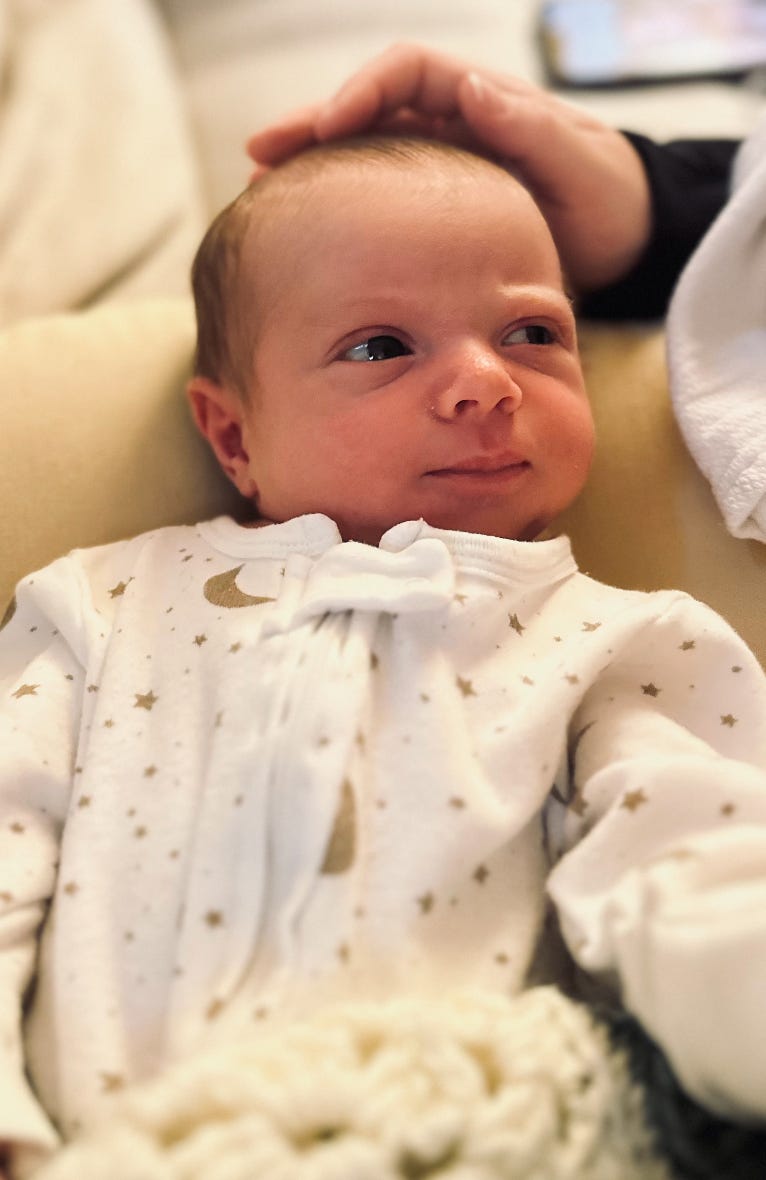
I show him pictures of Felix on my phone.
In a few hours, Altadena Hardware will be among the first structures reduced to ash.
🔥🔥🔥
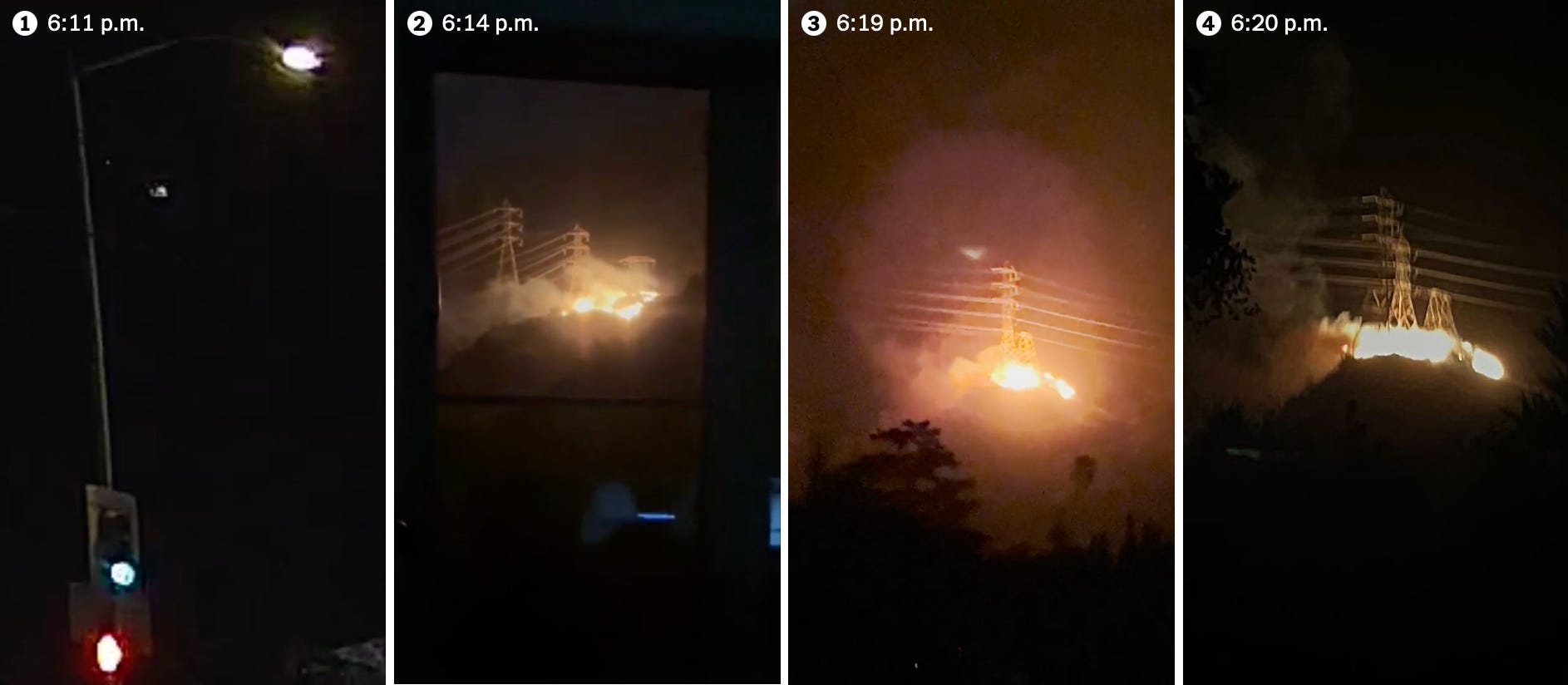
Internal SoCal Edison guidelines call for “offlining” high-energy power lines when winds top 70 mph. At 6:11pm, buffeted by 100 mph winds, the high-voltage transmission towers in Eaton Canyon remain fully active. The lines flash and spark. Electricity “arcs,” jumping from wire to wire. Metal bolts heat to 1500 degrees, melt, and drop down into the brittle, heat-sucked brush—broomsage, manzanita: kindling. Within minutes, the base of the tower is engulfed in flame.
We hike Eaton Canyon. It’s where Jynx enjoyed his final walk. Crisscrossing trails climb to a waterfall with views that stretch across the San Gabriel Valley. Eaton is beautiful, in that scrubby Southern California way. And it’s close—the trailhead maybe a mile from our front door.
Source: Aerial image by Nearmap, fire extent from Cal Fire via The New York Times. Photos and videos (clockwise from top left): Security camera footage from Arco gas station; provided by Mikal Watts; Jeffrey Ku; Jennifer Errico
🔥🔥🔥
I park on the street to protect our tiny i3 from the thin avocado trees that droop over the driveway; in summer, ripe fruit drop and dent the hood.
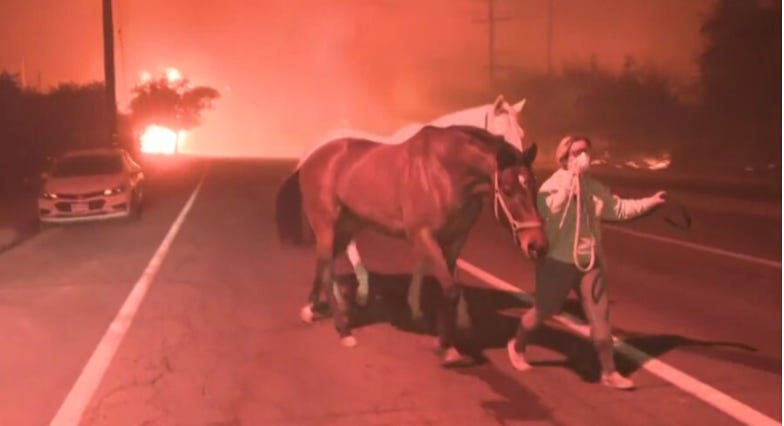
Uncha uncha uncha. Lo flips between KCAL and KTLA. The Palisades fires dominate coverage, but the anchors begin cutting to reporters in Altadena. The Eaton fire is rolling down the canyon. Residents of hillside streets like Loma Alta and Altadena Drive are evacuating. A man in an N95 leads two horses down Kinneloa Canyon Road. The sky is dark and red and the hills are burning. A reporter explains that Altadena is threatened by a “mountain wave wind,” a gust that strengthens when it hits the flatlands.
Source: KTLA
The ‘Are you OK/should you evacuate?’ texts start pinging in. I’m mildly annoyed when Lo tells the Heimer Family chat that we’re “Preparing to evacuate.” The fire’s east of us, and the wind is pushing it towards Sierra Madre—we’re in no danger. My Connecticut parents (what do they know from wildfire?) will be spooked.
“But,” Lo says, “we are prepared to evacuate.”
I patronizingly explain that “Prepare to evacuate” is a term of art, suggesting imminent evacuation. “We haven’t even lost power.”
Uncha uncha uncha.
🔥🔥🔥
The vibe starts to turn between 7 and 8pm, right around when Lo almost dies.
I ask Lo to turn on the sprinklers and angle the nozzles towards the house. (A spray of windswept embers seems unlikely, but a wet roof couldn’t hurt.) I would do it myself, but I’m rocking the baby, and, also, I don’t know how. Lo handles the sprinkler timers, alarm system, water bills, the replacement of filters and our more complicated bulbs (those recessed downlights with the flanged trims are very tricky), hanging art, and some light plumbing. I’m in charge of the French Press, the car tires (inflation and rotation), and figuring out which platform is streaming what movie.
We both pull our weight.
Lo opens the reinforced security door and steps outside. A second later, she screams. I throw open the door. Felix wails. She shoves past me, descends into the rumpus room, and sits on the floor.
After 10 years, I thought I knew her every facial expression. Not this one.
“What happened? What’s wrong?”
What’s wrong is that she’s just experienced near-death. The Ring footage shows the avocado tree crashing to the ground. Lo screams and flinches back. Its unforgiving trunk slams into the exact spot where moments later Lo would have crouched over the sprinkler’s control box. Exit the house five seconds earlier, and her fragile skull would have been in the direct path of the falling tree. (Also: if I’d parked in my usual spot, the car would’ve been crushed. Foresight!)
A few minutes later, I clamber barefoot onto the lawn furniture. The eastern sky is orange and black. I feel heat on my face. And something else—clammy fingers palpating my guts: dread.
I fancy myself a perspective guy, Mr. On The Other Hand. My usual role is to remind everyone that whatever “it” is, it’ll probably be OK.Now, I have something like an epiphany: in life’s primal moments, my even-handedness isn’t wisdom—it’s asinine. There’s a monster rolling downhill. My family is in its path.
I go inside and tell Lo it’s time to leave.
🔥🔥🔥
The constraint on what we take turns out not to be our Power Wheels-sized electric car but our failure of imagination. My babbling nervous system knows something that my brain refuses to hear. I keep using the phrase abundance of caution. “We’re only leaving because I’m trying to think like a Dad,” I tell Lo.
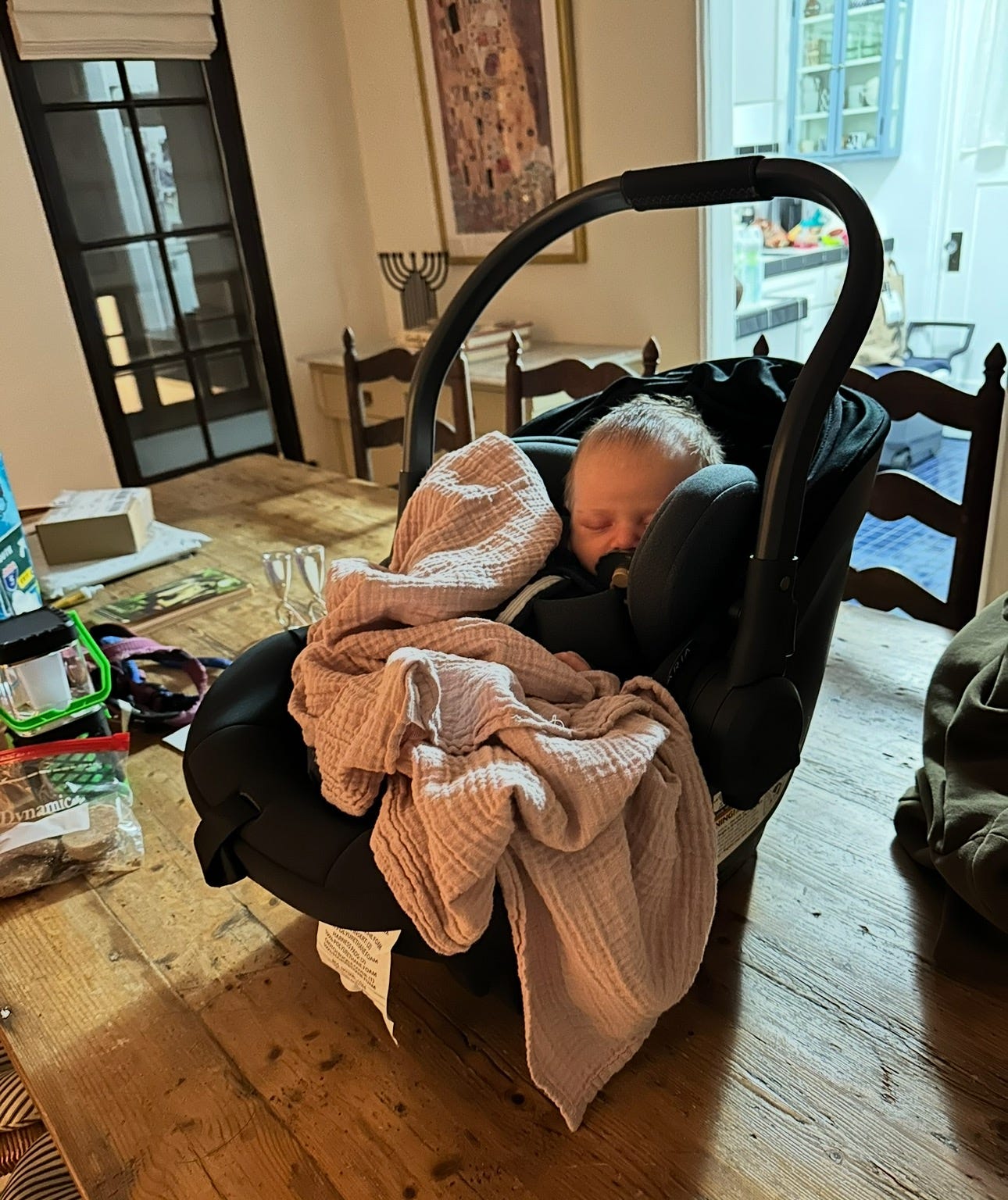
We take the car seat, the baby, the Strategic Milk Reserve, and the Dr. Browns bottles (nipples, leak-proof collars, fluorescent green anti-colic vents). Passports. Lo’s engagement and wedding bands. Two backpacks of sleepover gear: sweats and T-shirts you’d never wear out of the house (including a particularly unfortunate white T reading THE FORCE IS FEMALE—a Wasteland impulse buy that I regretted before I even left the store.) Lo’s Kindle. Two paperbacks.
Our friends had organized a meal train after Felix’s birth. It’s a bougie bounty of Erewhon readymades and Milkfarm cheese, and I can’t stomach the thought of it all spoiling while we’re gone. So I salvage the kale salad, the giant white beans, the spicy yams, the artisanal beef jerky, and the Swiss chocolate peanut butter cups.
We leave behind Lo’s jewelry, bags and clothes, and our laptops. Dozens of my dictaphones and journals dating back to junior high. The handwritten letters from my grandfather. Grandma Esther’s green card. The rugs Grandma Tirzah brought from Austria. The art (some inherited, some purchased ourselves) we dearly love. The Martin guitar my Dad bought me for my Bar Mitzvah. The record collection Lo’s grandfather, Gava, left her. And so on. We leave it all behind and we lock the door and we set the alarm and we wonder aloud if we’ll be back tomorrow or the day after.
As I’m carrying Felix, swaddled like a Bedouin, to the car, I see Stephanie from two doors down knocking at the home of our elderly neighbors. Leo and Charlene are in their late 80s and don’t get around too well.
“We’ll see you soon,” I tell Stephanie.
“You take care of that baby,” she says.
I take this picture as we leave the neighborhood:
It will be 48 hours before I think to eat again. When I open the tupperware, the spicy yams are coated in green mold.
🔥🔥🔥
Movie analogies are lazy, but, then again, so am I. Fleeing Altadena is Escape from Unincorporated L.A. It’s Mad Maxian. I feel like Pierce Brosnan in Dante’s Peak, short, dark and handsome in the right light, outracing volcanic magma.
Whole trees have fallen across Lincoln; we improvise, taking sharp Ms. Pac Man turns down side streets. Transformers explode. Debris swirls and smacks. Lo points out a tarp rising like a magic carpet through the ashy sky. Plot twist: in End Times, Angelinos drive like Topekan church ladies. At darkened intersections, perfect four-way-stop etiquette reigns—lots of yielding, lots of waving our fellow motorists through. On the freeway, everyone drives the speed limit. No one tailgates or passes, even as power lines spark above us.
We don’t see a single fire truck, ambulance or cop car.
We drive to the end of the 2, merge onto Glendale Ave, and re-enter the untouched world. We pass the reservoir and descend into south Silverlake. I feel like a soldier on leave—bemused that just miles from the front, there’s no war at all. Bars are open. Cops chat outside the 7-11. The dog park is full.
🔥🔥🔥
Poor Sophie.
In search of psychic salve after successive seasons of punishing loss, she decamped for Costa Rica, relinquishing both her phone and the illusion of self during a weeks-long, shaman-supervised ayahuasca trip. When, days from now, she will reactivate her phone, glowing with galactic balance, she’ll discover that her city is on fire and we are squatting in her house. Her absence—and Lo’s possession of her spare key—is our good fortune. (Our postnatal sacral-cranial masseuse swears Felix has an unusual capacity for stillness, but I can’t stomach imposing on family or friends who’d feel duty-bound to groggily insist that no, of course they didn’t hear him screaming from 2 to 5 a.m.)
Sophie’s is a chic landing spot, a 1920s Spanish duplex down the block from Barbara Stanwyck’s house in Double Indemnity. It’s freezing and I can’t find the thermostat. It takes me an hour to figure out that I need to ignite a pilot light by twisting a tiny metal key on a brass floor grate. Either Felix is remarkably patient with my ineptitude… or he’s so fucking cold he shuts down into self-preserving hibernation.
Lo would’ve sussed it out in two minutes. But it’s been almost four hours since her last pump, and if she hits five, her breasts explode like the bus in Speed.
🔥🔥🔥
We sit up in Sophie’s bed, bathed in screenglow. Local news streams on the iPad. Lo scrolls Instagram and TikTok (#EatonFire #Altadena). I toggle between Twitter, the Ring App, and Watch Duty—the suddenly ubiquitous crowdsourced wildfire-tracker that overlays real-time data onto an impenetrable interface: red dots for fire, red shading for active perimeters, orange for possible evacuation, pink for areas that may soon turn orange. We take turns holding Felix, who drowses fitfully in our arms. Each time we hit refresh feels like pulling the arm on some diabolical slot machine.
The Ring App hosts a panicked message board for West Altadenans, endless variations on: “Anybody know if Mariposa between Lincoln and Fair Oaks is OK?” Replies are mostly prayer hands emojis and question marks. As 11 p.m. bleeds into early morning, late evacuees offer ominous updates. Purported eye-witnesses swear they saw local businesses burning—Unincorporated Coffee, Amara Cafe, the B of A on Lake. Other neighbors demand pictures as proof, suggesting—hoping—that the rumors are just trolls stoking panic. That level of misanthropy seems hard to imagine. But I’m also struggling to believe police scanner reports of widespread looting, demons in balaclavas ransacking burning houses.
I post: “Any eyes on Devirian Place east of Lincoln?” I get one reply: 🙏🙏🙏.
When I pass out around 3 a.m., Felix cradled in my arms, Watch Duty shows all of West Altadena freckled red, shaded pink, or speckled with orange flames.
🐣🐣🐣
That last sentence’s seemingly-innocuous second clause demands a footnote.
The second-most important goal of first-time parents is to raise a resilient, curious, sound-sleeping, neuroses-free Soft Boy Superman. From hand sanitizing bottles to sleep training, pacifier policy to book selection, each choice bears the weight of shaping the Future Man to whom this child is Dad.
However. The primary goal of the first-time parent is not to kill the baby.
My general approach to fatherhood could be summarized as: Billions have survived worse. But even I wouldn’t fuck with that most verboten of fate-tempters: co-sleeping. Nurses, doulas, doctors—the messaging is unrelenting: even a cat nap with your baby is a slippery slope to suffocation and smotheration, a skull smashed by rogue elbow or nightmarish spasm.
But none of the baby books have much to offer on what to do if you’ve forgotten all of your sleep gear during a natural disaster. Without a better option, we mount Felix on a foam pillow between us in bed, hoping that a sturdy platform and little good luck will keep him from harm. It feels insanely cavalier, like when Paulie Sherman and I shared the cigarette he had stolen from a pack brandished by the DARE detective who showed our 6th-grade class pictures of emphysemic lungs.
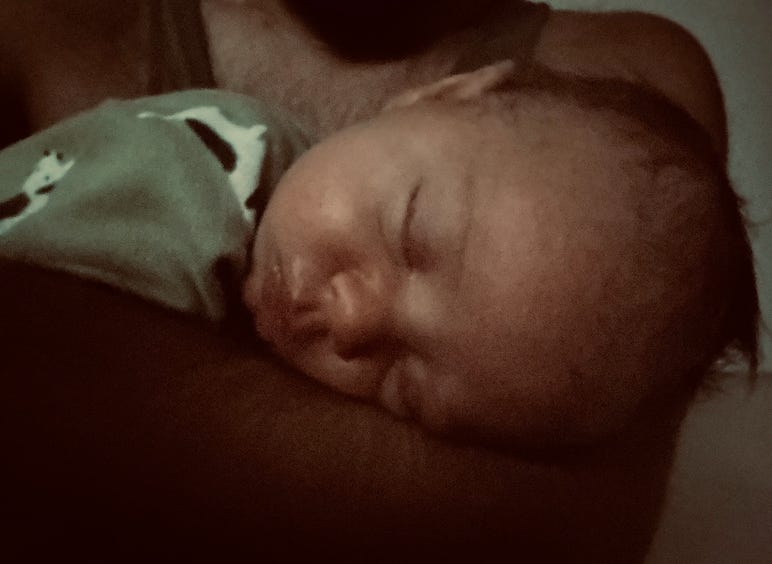
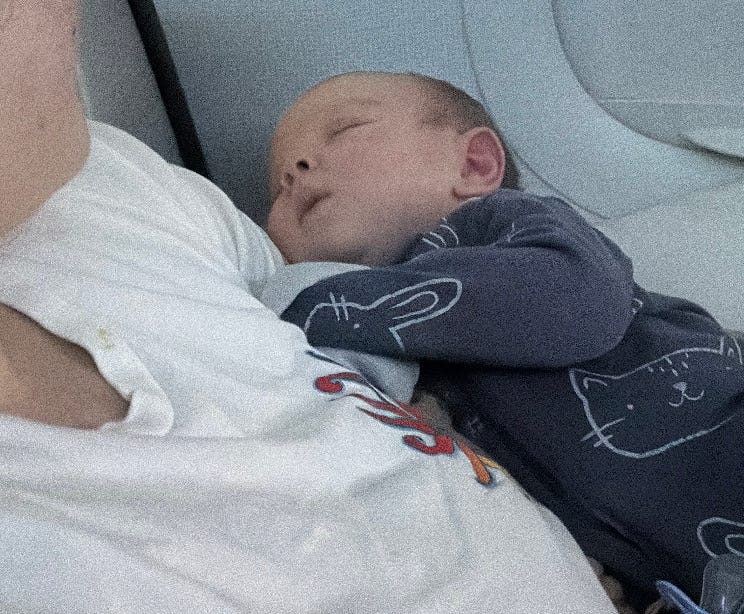
But, sort of like that detective, the co-sleeping finger-waggers leave out a crucial detail: the drugs feel so, so good. In his first month, Felix has never slept more than two hours at a stretch. Tonight, his tiny hand cups my cheek, head tucked between pec and biceps, and our breathing syncs as he drifts into a deep slumber. He snores, weakly tapping my chest like the world’s smallest drunk emphasizing a point before last call. It’s intimate, it’s mammalian: it lasts almost 5 hours.
When I confess my misgivings to our friend Alie, she tells me that now is not the time to worry. “You’re in survival mode. You can’t make plans or evaluate behavior. Go easy on yourself.”
Fantastic! The permission structure is soothing and spammable. Standing in the open fridge at 2 a.m., eating half-a-gallon of Edy’s Butter Pecan? Survival mode! Ignoring concerned texts because I’ve got $75 on the Capital One Orange Bowl? I cut myself some slack. Survival mode, baby! Go Irish!
🔥🔥🔥
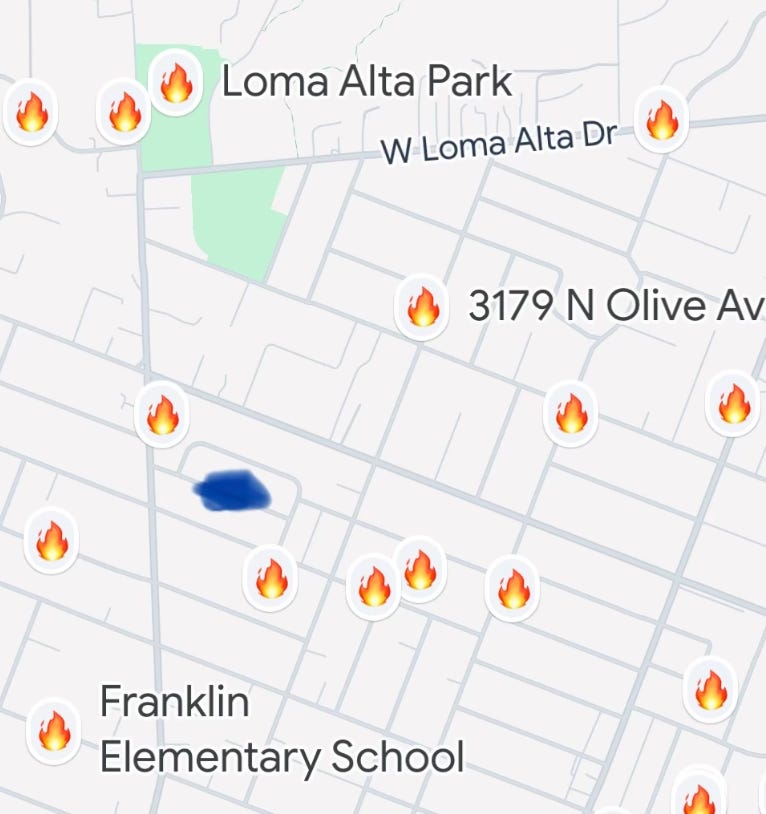
We wake to gray dawn and the news—according to Watch Duty—that our house is probably on fire.
Our block is the blue splotch
On January 8th the whole city realizes that we’re living through a generational catastrophe. LADWP issues a county-wide water contamination warning. We boil pots of tap on Sophie’s ancient Wedgewood—a match-lit, gas-hissing antique—then use it to scrub the baby gear with soap and scalding water. By day’s end, Lo’s fingers are bleeding.
If mid-day car chases are the Sunday football of local LA news, then wildfire is its Super Bowl. Brave—it feels weird to use the word in earnest—reporters move street to street, documenting each block as it’s consumed. KTLA’s John Fenoglio, a former volunteer firefighter, grabs a garden hose and helps to rescue a home licked by flame; a tireless Annie Rose Ramos stays live for hours without rest or food. Their vocabularies shrink. Apocalyptic. Devastation. Unthinkable. The more massive the destruction, the fewer words seem equal to describing it.
Ramos could almost be following wonky Waze directions to our house. She walks down Mariposa and the camera follows her finger: we know these houses. Peter’s is on fire. Javon’s is on fire. Poppy’s is on fire. Ramos moves north up Olive, two blocks from our house, then one. I’m yelling at the TV, like it’s a Mets playoff game. Only instead of pleading with some middle-reliever not to groove a fastball, I’m urging Ramos to pan west. Show us our house. Point the camera at our house!
When Ramos succumbs to a racking smoky chest cough, coverage is redirected to the Palisades. When the anchor throws back to Altadena, it’s a different reporter and he’s miles from our house. I imagine Ramos being wrestled into the news van by her concerned cameraman, as, still coughing, she attempts to break away and keep broadcasting.
Once you see your street on fire, you’ve hit peak news. We enter a state of Schrödinger’s House: 123 Devirian Place is surely gone; until we see the ashes, 123 Devirian Place is fine.
There is, however, no quantum uncertainty concerning West Altadena: that cat is dead.
🔥🔥🔥
In the weeks after the fires, it feels like every other story on NPR and in The New York Times is about Altadena. But until it burned, our hometown was LA’s best-kept secret. We planned to live there forever. Our most audacious dream was to level up from Devirian to Mariposa or Altadena Drive—from our modest bungalow to a mock Tudor with criss-crossing dark-timber accents.
We lived on the edge of Janes Village, a cluster of “English fairy-tale cottages” built in the 1920s by Elisha P. Janes. His guiding principle was whimsy: peaked roofs, Suessian silhouettes and arched doors. Each house was quirky and distinct, yet better for being part of an integrated whole.
Best of all (I would say when I played tour guide), E.P. Janes wasn’t actually an architect but a grifter, a high-school dropout who roamed the West peddling miracle cures and defective mail-order tires. Arriving in Altadena one step ahead of a federal indictment, Janes was immediately besotted by its cheap land and easily-obtainable building permits. Tweaking blueprints filched from the Central Library, Janes built 100 houses in (his words) “the timeless Norman style,” with nested “cat-side gables” and Cotswold roofs. He took out a two page ad in the Times that screamed WHY PAY RENT? in 100-point font. A deed could be yours for $150 cash down. No escrow charges. Taxes fully paid.
Half a century later, that gospel of homeownership found a congregation Janes surely never imagined. In the redlined 1960s, banks wouldn’t write mortgages for Black families east of Lake. So realtors steered them west, toward Janes Village. West Altadena became prosperous, with one of the first Black-owned Savings & Loans west of the Mississippi, a doctor’s row, and 80% home ownership on blocks of teachers, lawyers, and small businesspeople. Jackie Robinson, Sidney Poitier, and Octavia Butler all lived there. That original E.P. Janes ad concludes: “A More Liberal Proposition Was Never Offered.” Which: chef’s kiss perfection. The fly-by-night con artist who, seemingly by accident, built quality houses and a timeless community.
Janes Village front yards were lush and fussed-over; there was a neighborly-but-competitive spirit around holiday decor, and at Christmas the whole neighborhood glowed red and green and gold. Every block had a little wooden Take a Book Leave a Book lending library. One champion gardener would leave cut roses soaking in a white plastic bucket on the sidewalk for passersby; another neighbor taped handwritten signs to her picket gate: Fallen fruit first come first eat!
🐣🐣🐣
The Sunday before the fires, Felix turns four weeks old, and we begin to emerge from the bomb shelter of early infancy. Going for a walk around the block feels like a precarious adventure. I keep imagining that when exposed to fresh air, Felix will disintegrate like a disentombed mummy. After I build the stroller, I wait until Lo takes Felix to the nursery, then clandestinely load it with dictionaries to reassure myself that it won’t collapse under his weight.
The Glenrose loop, normally a twenty-minute walk, takes an hour. We’re stopped again and again for baby appreciation and parental wisdom-sharing. Eight weeks and you’ll start to get some sleep and The stork’s kisses on his eyelids mean he has a warm heart. We’re told he looks like Lo; we’re told he looks like me; we’re told to hurry up and call Gerber, call Michelin. The ancient Black widow who lives at the corner of Terrace and Olive pats Felix’s head. “You got a boy on the first try?” she asks. I nod. She grins up at Lo. “Daddy must be real proud.” I admit that I am.
It becomes clear that Felix gives us a patina of permanence. Neighbors who had been cordial but distant—perhaps suspecting us of dilettantish transience—now see us as settled. In short, Felix speaks well of us.
We meet a neighbor named Poppy out with her own kids—7 months and 2 years. She tells us all the things we’ll enjoy with the baby as the weather warms up: outdoor readings at the library, Mommy and Me singalongs in Charles White Park, petting hours at the horse farm.
“Spring in Altadena,” Poppy tells us as we exchange numbers. “It’s the best with babies.”
🔥🔥🔥
I reassure my parents: we’re safe in Silver Lake. Mom sounds concerned, so I send Watch Duty screenshots to prove we’re well clear of the Red Flag Zone. I emphasize our nearness to the reservoir—like we might escape the fires by diving in. She asks if I remembered my inhaler; she reminds me that Uncle (Dr.) Roy could call one in to the nearest Rite Aid. I look up at the low bank of smoke, thick as theatre curtains, ominous as Oobleck, and assure her that my asthma shouldn’t be a problem: the Silver Lake air is pristine. Unconvinced, she tells me that on All Things Considered a reporter compared the LA air quality to Mexico City’s in the late ’90s, when the PM2.5 index regularly hit 900, and children were warned not to play outside.
Not Silver Lake, I tell her. Not here by the water.
🔥🔥🔥
That evening Margot drops by. She spent the previous night at her producer’s mother’s house after evacuating the Hollywood Hills with only her cats and her Chanel bags.
“You take the oddest things in a crisis, don’t you?” she says.
Lo nods glumly, visualizing, I suspect, a wall of fire consuming her own bags.
Margot presents skincare elixirs and perfume to a grateful Lo, and a Tushbaby carrier to a snoring Felix. Then she declares she’s going to make us soup. Although she insists it’s her “famous soup,” a recipe that has sustained her through times of tsuris and sorrow, I steer her away from beginning a broth. For one, Sophie’s ancient kitchen feels more ceremonial than functional. But also, Margot is a Glamorous Figure of Some Public Renown and doesn’t strike me as a plausible source of soup.
She’s the first person to ask what we’ll do next. I hear myself admitting that a stint with my parents in Connecticut might make sense—but even as I say it, the idea feels overwhelming.
“Growing up in the suburbs, the one thing I wanted was to get out of the suburbs. Not living in Connecticut has sort of been a guiding principle of my life.”
“Well then, let’s not think of it as going back to Connecticut,” she says. “You and Lo are aliens fallen to earth, and everything is wild and new.” She makes a dramatic hand gesture, widens her eyes. “Co-nnec-ti-cut,” she says like E.T. sounding out Elliot’s name. “Think how amazing the snow will be. As aliens, I mean.”
Then, over my protests (which I overdo, mildly insulting her), Margot makes soup, a surprising, hearty, dues-paying stew. We haven’t eaten in two days; Margot is, in fact, a Genius of Soup; it’s the best thing I’ve ever had.
🔥🔥🔥
Thursday morning, Ari comes bearing coffees. We’re FaceTiming with his wife Annie, mid-recap—‘abundance of caution,’ our final walk, Schrödinger’s house—when Lo’s phone rings.
She answers. Listens. Her face falls. “He’s sure?”
He is.
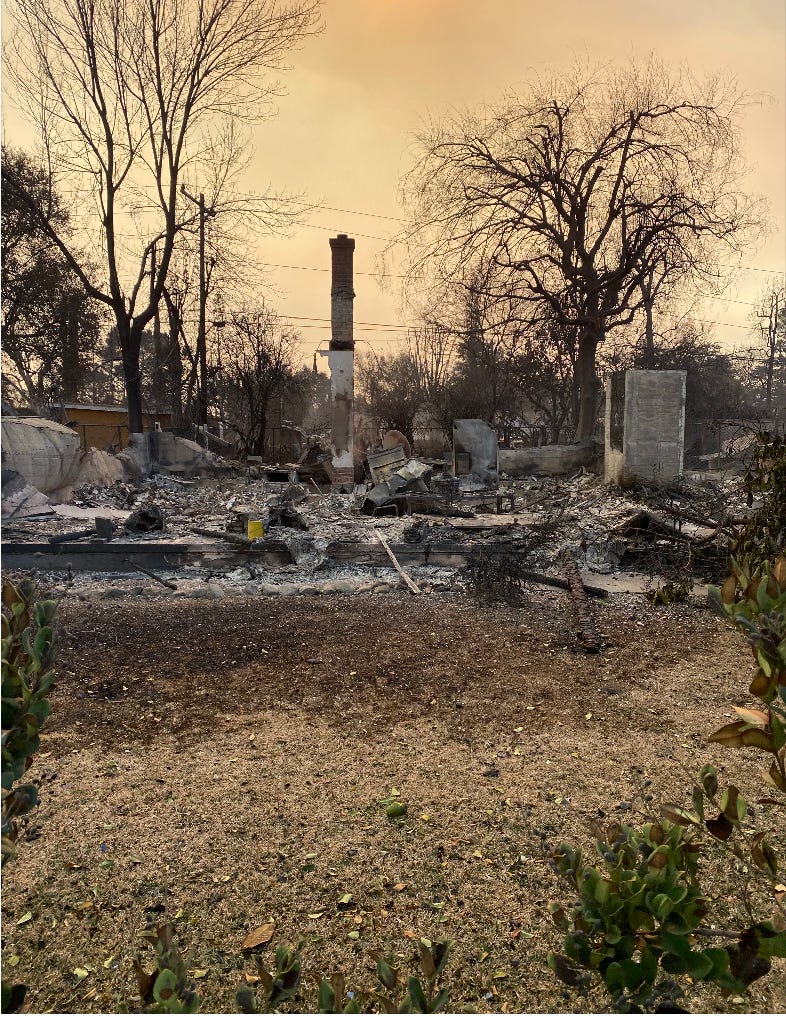
A neighbor had asked a firefighter buddy to drive through and take pictures of each lot. This is ours—
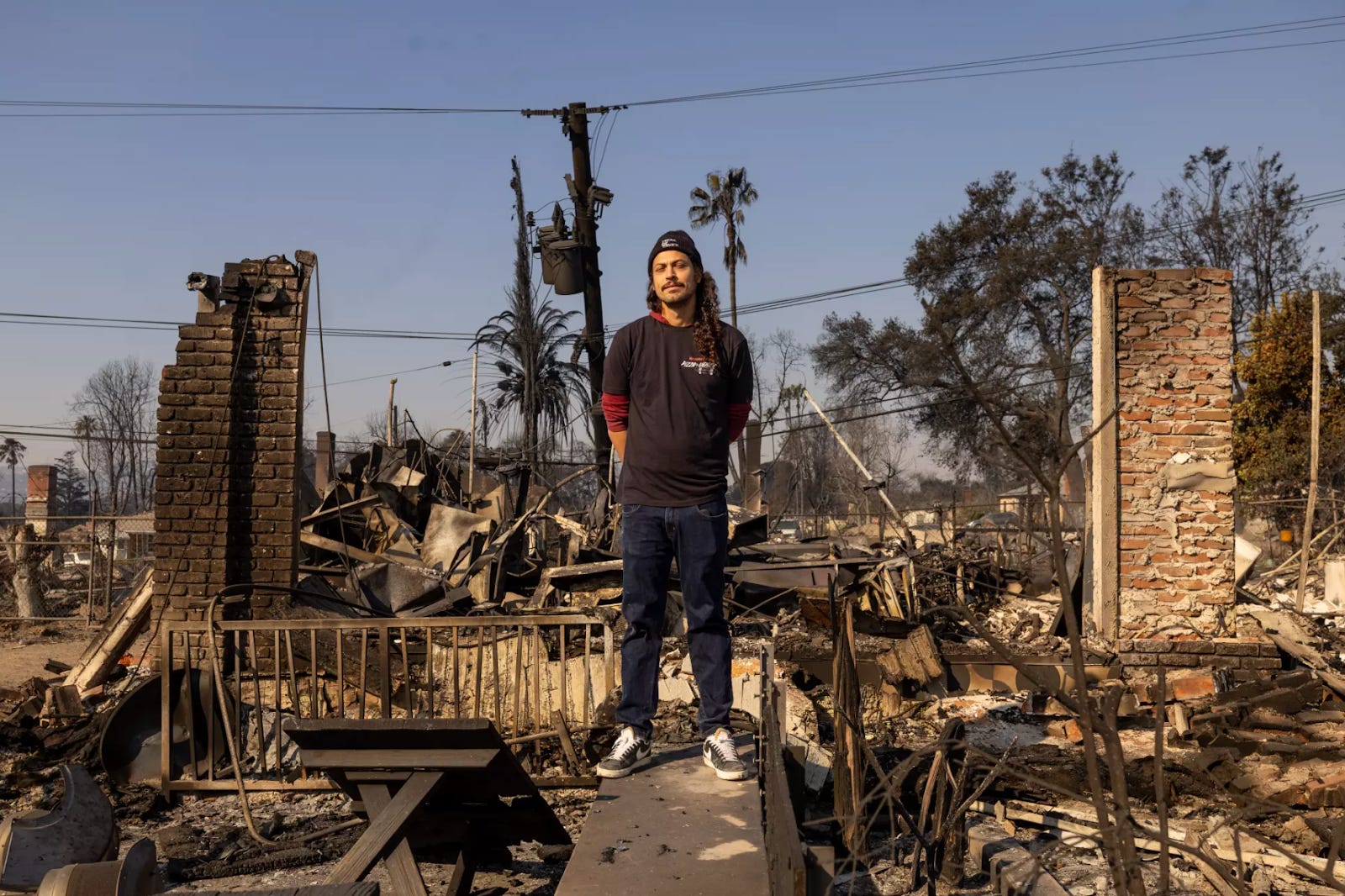
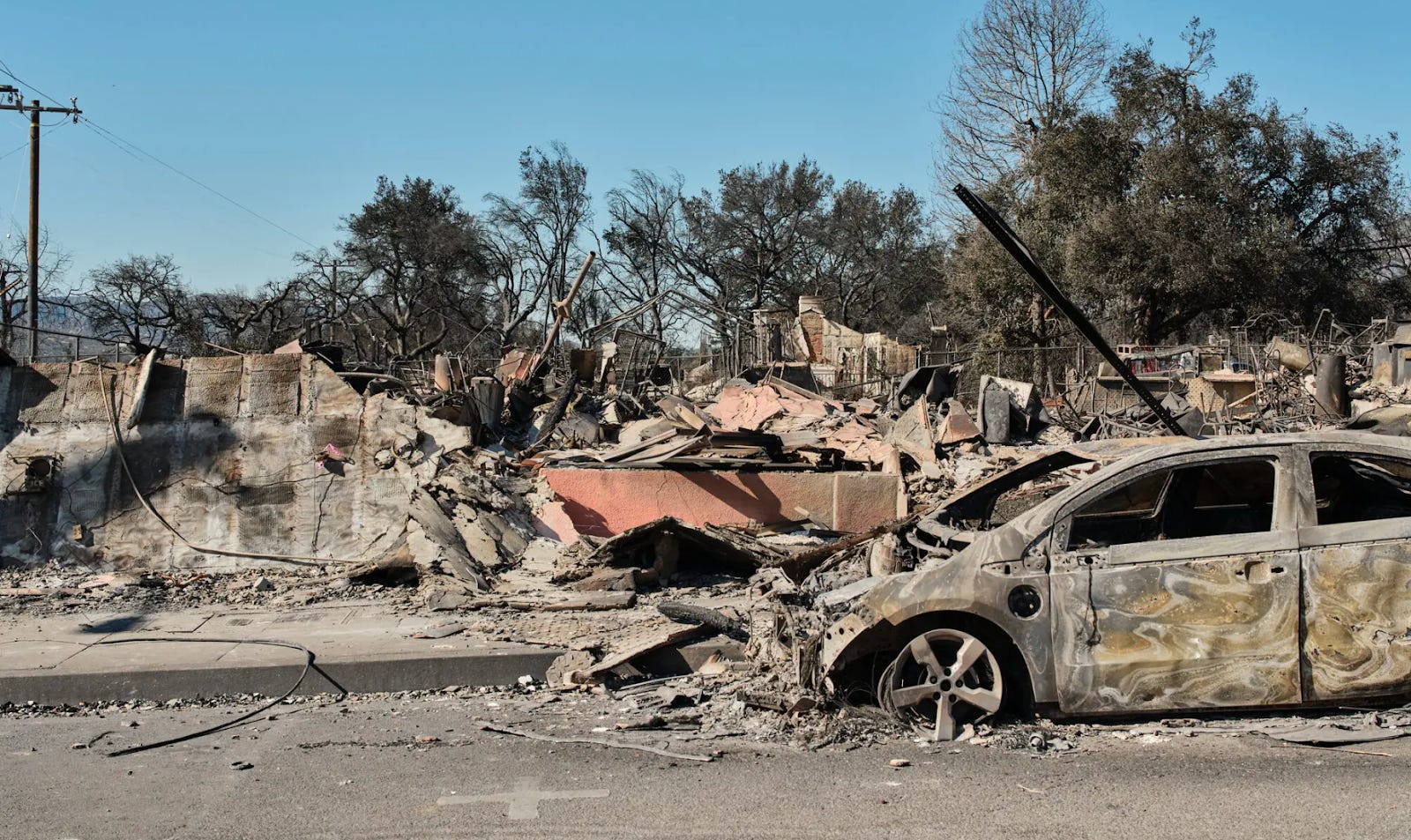
Turns out houses are like people—however unique in life, their cremated remains all look the same. Our home. Our things. The spaces that held the rhythms that shaped our days—gone. A spindle of a chimney. A heap of drywall and pipe.
Lo sits very still and cries.
Uncha uncha uncha.
🐶🐶🐶
We have this stupid, sweet dog. I was on a walk when I saw her out in the middle of traffic. Some LA street dogs—like those scrappy white mutts that own Glassell Park—make dodging cars look comfortable. Not this one. Flinching late, turning wrong, alive by accident. I wave my arms, run out onto Lincoln, and scoop her up.
I can use the karma.
No tags, no chip. We name her Salem and plan to rehouse her. She has bulging eyes and a bald, shiny crease on the crown of her velvety head. When people ask what happened, we shrug: “Nothing good.” Lo has floated the idea of a pet psychic, but only if we can find “a really good one.”Which, agreed.
Jynx shows Salem the ropes, tolerating her in an Ed Asner–meets–the-kid-from-Up kind of way. He growls when she pees in the house. He makes a bit of room for her at the foot of the bed.
Lo found Jynx tied to a fire hydrant outside a Greenwich Village bakery. She passed him on her way to work; when she walked home that afternoon, he was still there. The asphalt was hot and he looked thirsty. She untied him, shampooed him in her sink, and took him to the vet to get him chipped.
“Bakers work long hours,” I point out. “He probably belonged to one of them. You stole a baker’s dog.”
“I guess it’s possible,” Lo concedes. “But he wasn’t living his best life.”
Two weeks after we find Salem, Jynx collapses in the Great Room. He’d carried a stomach tumor for months without complaint, until it ruptured, flooding his abdomen with blood. The vet puts him down. Lo and I sit on the curb of the Emergency Animal Hospital parking lot and cry.
That night, Salem slips through a narrow gap in Sophie’s backyard gate. I scream her name and chase her into the street—both mistakes, because she thinks we’re playing and scampers happily into traffic. A girl on an eBike with a ukulele strapped to her back misses Salem by inches and flips me the bird. “No, fuck you!” I yell and immediately eat shit coming off the curb. I regain my footing, fall again, and now the dog returns to me—she’s never seen me bleeding before, and she’s curious.
I sit in the street with the dog licking my elbow. A woman in her 70s calls down from a second-floor balcony.
“Are you OK? Do you need Neosporin?”
“I’m fine,” I say. “Our house burned down.”
“You’re having a bad week,” she says.
🔥🔥🔥
In L.A., when you swap numbers at a party and promise to grab coffee, it’s universally understood that you won’t: following up would be a breach of etiquette. But not for Lo. She could levitate or transmute iron to gold, and it wouldn’t seem any more alien to me than watching her turn a Halloween drinks table meet-cute—“I’m obsessed with your costume. Are you Jessica Rabbit or Veronica Lake?”—into a lifelong friendship. Lo doesn’t network. It’s more like she acts like everyone is already in her phone—only, through some cosmic oversight, their number got lost until now.
Newly engaged but new in town? Lo will track down Oprah’s florist, Paris’s jeweler, and an event band that crushed the Hora at Slash’s daughter’s Bat Mitzvah. Crisis: you need your unexpected pregnancy to go unnoticed at your brother’s wedding. Lo will march you from atelier to tailleur until you feel chic and look svelte. If—God forbid—your dad gets sick, Lo will spend her Saturday calling everyone she knows and everyone they know. If it’s nightfall by the time she gets the cell phone of the chief surgeon at Sloan Kettering? Don’t worry—she’s happy to ring her at home.
I’d say she makes it look effortless—except, of course, the effort is the point.
At dusk, we open Sophie’s front door. The patio is crowded with bags of clothing and groceries—and an entire nursery of ridiculously named gear to replace what we lost in the fire. Stroller and car seat (Doona and Nuna), crib, Moses basket, Pack n’ Play and bassinet (Babyletto, Graco, Lalo and Bumbo), bouncer, carrier, diaper bag, sound machine, onesies and sleep sacks (BabyBjörn, Hatch Baby, Skip Hop, Little Unicorn, CuddleCo).
Lo has only told a few friends about the house. But some citywide Bat Signal went out—Lo is in trouble—and everyone in Los Angeles answered the call.
It’s the only time that I cry.
🔥🔥🔥
We have a crib again, and a bassinet, but, fuck it, we keep co-sleeping. Survival mode!
🐣🐣🐣
If you absolutely can’t avoid having your house burn down, I highly recommend doing it with a newborn. If, hypothetically, you’re in a city where a wildly mismanaged fire burns 10,000+ homes, the kid helps you stand out, like a college applicant with an unusual extracurricular. Plus, the kid gets a mythic origin story, real phoenix shit. Most usefully, the baby gives you something to do. After Katrina, my friends Jes and Richard spent a month in Shreveport watching Entourage reruns, paralyzed by fear and loathing. Felix has milk to drink and diapers to change; he catalyzes motion.
His obliviousness is an oasis. At four weeks, Felix is pure hardware—blinking, twitching, resetting. Even with the city on fire, I spend a lot of time Seinfelding. What’s the deal with infant cognition?
Felix sees shapes, feels sensations, hears pulses of noise, but he’s unmoored from logic, immersed in raw experience. If you’re the kind of person who’s ever said yes to the third tab, then you might guess that what Felix is experiencing resembles an overwhelming psychedelic trip. Or, more precisely, that a heavy trip approximates the experience of infanthood. Enough psilocybin and the boundary between self and surroundings dissolves. Time fractures. Shadows breathe. Your cells sing.
Now imagine that’s your baseline. For Felix, everything is immediate, vivid, unknowable. The glow of a ceiling light. Hunger’s uncomfortable pang. The warmth of a parent’s body. Each must feel encompassing and eternal.
And I guess my point is just—I may no longer be a sock owner (evacuating in Birkenstocks being just one among my many questionable choices), but it’s still nice to imagine the four-week-old seeing the face of God in a ceiling fan.
🔥🔥🔥
At some point, the unthinkable becomes the inevitable: for some indefinite stretch, we’re going to move into the house where I grew up. A chemical haze stretches from La Cañada to Long Beach, a toxic gunk of incinerated homes and cars. Babies (their growing lungs breathe more air, more often) are particularly vulnerable. Displaced families scramble for housing. Prices spike. There are Reddit rumors of gouging and bidding wars, tenants offering a year’s rent in cash. It’s untenable.
There’s one thing I feel I must do before we leave: I have to see what’s left of the house.
My reasons are fuzzy and half-formed. Maybe I want my Vito Corleone moment: cradle the corpse, wailing: “Look how they massacred my boy.” I want to clench fistfuls of ash, pound the earth and swear with God as my witnessI’ll—what, exactly?
I can’t shake the fantasy that something survived. Something the fire missed and the looters overlooked. I keep replaying our last frantic minutes: I saved the kale but left the jewelry. Took the white bean salad, lost the journals.
Thursday morning, I ask Max to drive me back to Altadena. Max was my first LA friend and my first call whenever I need help disposing of a body. He’s a successful character actor who specializes in wide-eyed underdogs—you know him as a neurotic, self-deprecating werewolf or an eager but out-of-his-depth sidekick.
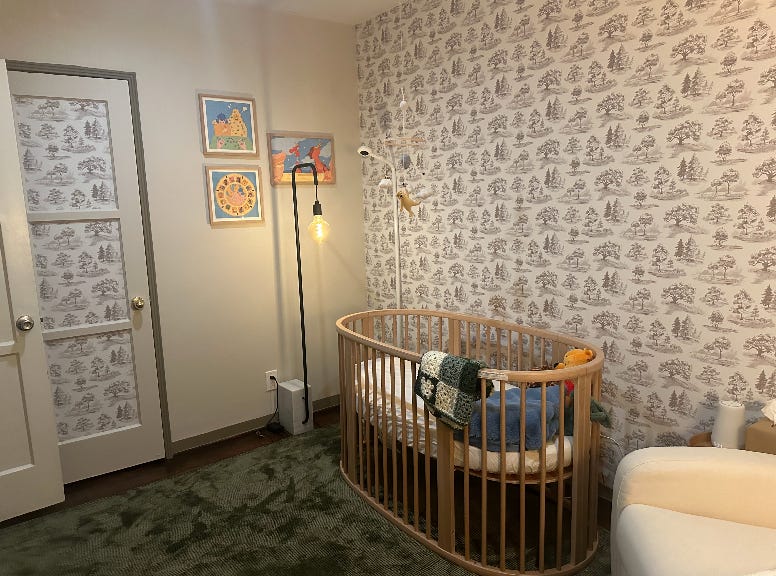
The month before Felix is born, Max builds our nursery. He’s a veteran dad, so he lets me pretend I’m helping. I pull the wallpaper taut while Max smooths each sheet into place. I tape the edges; he paints the trim. Max’s work is meticulous, dazzling. Lo says it’s her favorite room—not just in this house, but in any house.
We spend Felix’s first month in that room, surrounded by the wallpaper Annie picked out, the paint Max applied, the trim Dani designed, Kerri’s Pooh mobile, Olivia’s ceramic owl, Mambo—the nearly life-sized giraffe my mother-in-law brought to the maternity ward. It’s where we get to know Felix during midnight feedings, nose to nose and eyeball to eyeball, moonlight spilling in across the backyard.
It’s where Lo and I discover each other as parents. We slip into the rhythms of infant care like line cooks navigating a tight back-of-house, bumping into each other, half-awake, mumbling in fridge light. We stumble from bed to bassinet, leaden and dumb. When words fail, we grunt.
Time accordions. It’s always blackest night or golden dawn—though who can say which, or what day it is. We share delirium like a thick quilt in winter, pulling it up to our chins, wriggling close beneath it. We run sound soothers in every room, 24/7, always on the “autumn rain” setting. We never venture outside. Eventually I accept that we live snug, sleepy, and sheltered from some endless storm.
Acting on a bum tip, I think flashing my ID will get us past the National Guardsman posted at Lincoln and Washington. Not so.
“Sorry,” he says, not looking particularly sorry. “Crime scene.”
I show him my license, my address. He doesn’t even glance at it. “Crime scene,” he repeats. “Police matter.”
Max and I drive around before heading back, turning up any street without a Guardsman. Touring the destruction.
The ruins read like a eulogy for Altadena:
Pizza of Venice, its brick oven now a lonely husk, buried in ash and fallen string lights, each tiny bulb exploded by the heat.
The Little Red Hen—bought in the ’70s by a silk finisher and her three daughters, who served chicory coffee and grits for half a century.
The Bunny Museum—yes, the world’s largest collection of bunny-related items, founded by a couple who exchanged bunny gifts every anniversary. It was empty most of the year and packed at Easter.
Mountain View Cemetery, scorched but salvaged. The final resting place of Octavia Butler, Cassandra of Altadena.
Pizza of Venice
The Little Red Hen
“What the fuck,” Max says.
“What the fuck,” I say.
🔥🔥🔥
I go back alone the next morning. I’ve been running through all the semi-secret ways back into the neighborhood—like how the SuperKings parking garage links Washington and Ventura. Surely, not every route can be barricaded. It’s the National Guard, not the Locals-Who-Know-the-Nooks-and-Crannies Guard.
Washington Blvd is crowded. Volunteers hand out socks and T-shirts; others sit in metal beach chairs, glaring at the Guard. Camo’d soldiers stand in front of white SUVs, parked diagonally across every entry point into Janes Village. The guy I approach is in the middle of Lincoln, near the 24 Hour Fitness. He has a mustache and one of those Major Payne hats.
Can I go see my house? (No)
When will that change? (I don’t know)
Who does? (Shrug)
When will the information be updated? (When there’s an update)
I go from Guardsman to Guardsman, asking the same questions. It’s petulant, slightly unhinged. At some point, I’m pretty sure someone walkies ahead about a suspicious and repetitious weirdo, because the answers shift. 'No' becomes 'Does it look like you can go through?' becomes 'Go right ahead if you feel like being arrested.'
🔥🔥🔥
As Lo stays up late compiling an inventory for the insurance, scrolling our photos for evidence of this rug or that necklace, it becomes clear: the magnitude of our loss is mostly her fault.
When we met, I was living in a house you might generously call a “bachelor pad.” Bare walls. A mattress on the floor, surrounded by teetering piles of books. One leg of my Wayfair sectional snapped a month in, and I never fixed it. If I had three guests over, one was expected to sit on the floor and lean against the broken couch stub like a Roman peasant. When Lo helped me move out, she opened the oven and found its instruction manual on the top rack: I lived there a year and never turned it on.
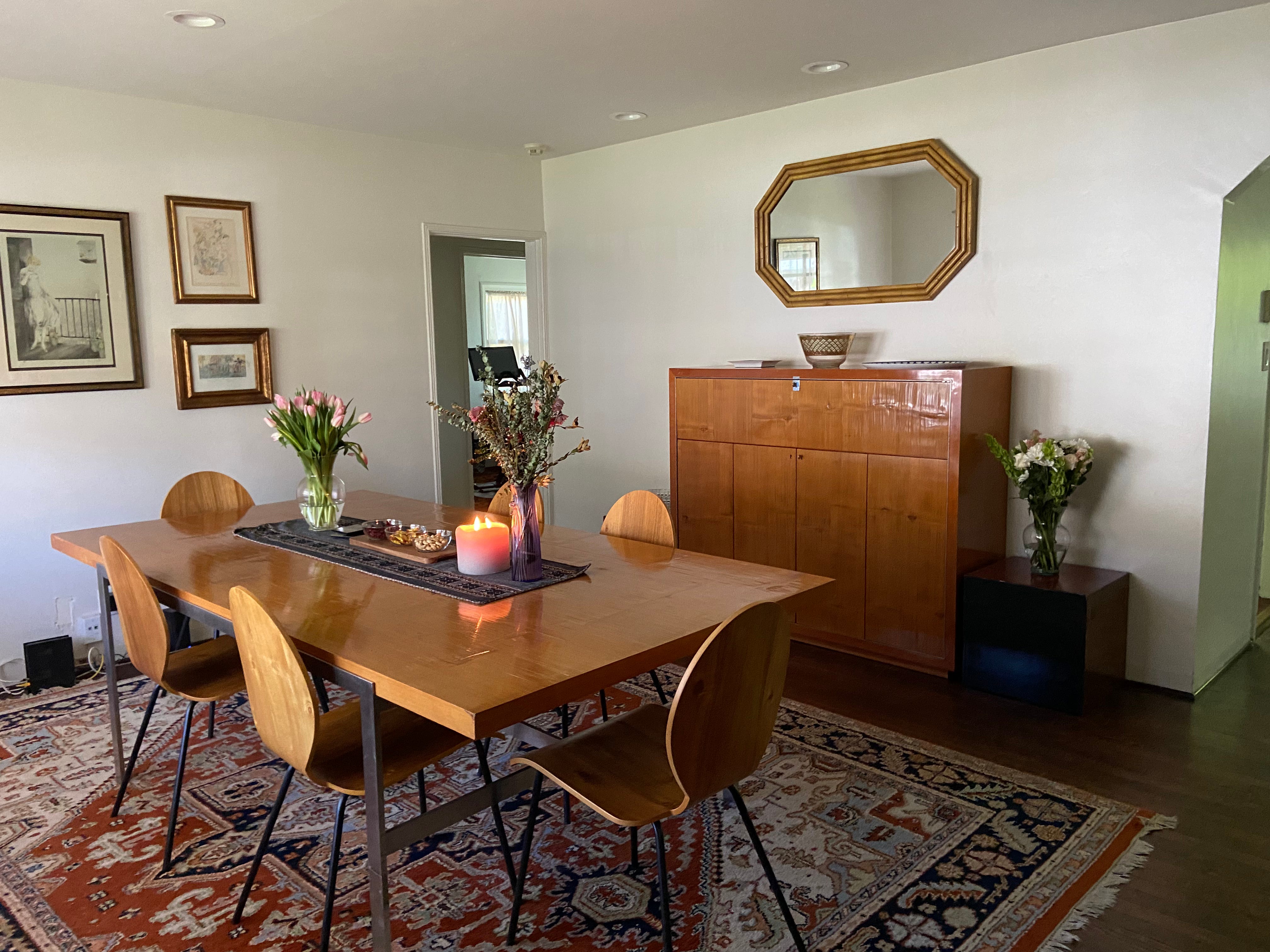
Our Altadena house was a patchwork: part Tel Aviv chic, part Hungarian card room. The lacquered bamboo sideboard (on long-term loan from my mother-in-law) faced the frayed Oriental rugs and the stern leather club chairs with brass nailhead trim, both inherited from my grandparents. Those heirlooms—along with a set of teak cabinets my Grandpa Gabi built and a dozen nearly identical charcoal sketches of shtetl streets, all in ornate gilt frames—had gathered a decade of dust in a Connecticut storage facility before Lo arranged to have it all shipped West. I was surprised by how good that stuff made me feel—familiar, quietly reassuring. Maybe I’d spent so long performing the “more cultural than religious” version of modern Jew that I’d forgotten I am, in fact, pretty Jewish—raised by Central European refugees, steeped in a decor language of dark wood, heavy drapery, and glass ashtrays.
Lo hung a dozen framed family photos in the hall outside the bathroom: my parents in law school caps and gowns; Grandma Esther glowering like Ma Barker beneath a Marge Simpson beehive; Gabi and Tirzah grinning for the camera on the SS Israel, the Statue of Liberty behind them as they approached Ellis Island. It was dowdy. It was sweet. And at least once a day, I’d stop in that hallway, glance up, and feel known.
🔥🔥🔥
Friday morning, we get a tip: a back way past the National Guard and into Altadena.
I’m in the car before I can overthink the risk of sneaking into an arrest-on-sight no-go zone patrolled by the National Guard. Which is probably for the best—because, as my friend Kevin once remarked when I had (long story) ended up with a valuable piece of stolen art stashed in the back of my closet: risk has been incurred
I back into a spot at a La Cañada church, nearly three miles from Janes Village. To reach the house, I’ll need to cut through Hahamongna Park, cross the scrubby wash in front of the NASA Jet Propulsion Lab, climb a dirt path to Altadena Drive, and slip through a half-dozen blocks to Devirian Place. I’ve been given the number of a fire captain in from NorCal—Jill—who’s allegedly willing to meet me at the house and help sift through the ash with her crew.
🔥🔥🔥
I’m adrenalized. I’m sneaking through the woods behind enemy lines: This is a cool plan! My Bourneian fantasies are only slightly dulled by the fact that I’m dressed like the Jamaican flag: red hoodie, black sweats, green and yellow Jordans. (After my adventure, Lo will make me trash the entire ensemble, because: micro-fibers.)
Hahamongna Park is all sandy gullies, shaded picnic tables, and stands of sycamores and cottonwoods. I feel good. A light breeze tousles the treetops. It has that virtuous early Sunday morning vibe, like I’m squeezing in a little one-on-one time with God while the rest of the flock hits snooze.
Then I hit the wash and things start to feel… precarious. NASA’s massive, heavily patrolled facility looms at the mouth of the Arroyo—anodyne, vast, and very much not a place to fuck with. An alarm blats continuously from the compound, very Rebel base under attack—man your battle stations! It’s not comforting.
On the video, you can hear me muttering: Lots of helicopters. That’s a black one. I don’t like the black ones. I’m leaving the path. Crossing the wash. If things get icky, this is when they’ll get icky.
When things get icky: Very cool, Jordan. Echt Liam Neeson.
The wash is rocky and flat and, I assume, strategic. Whatever they’re guarding at NASA, they prefer that strangers don’t approach unobserved. The high-noon sun throws my shadow long in front of me. I surf a grainy dune, hopscotch a stream, and clamber up an embankment. After I balance beam over a crevasse on a narrow board, you can hear me yell “Let’s go!” in the video—the world’s foremost dork.
🔥🔥🔥
Tires rumble over gravel, and a Forest Service patrol car pulls up beside me. The window rolls down, revealing a man with a shiny brass badge. Shit. In lieu of a plan, I decide to act as dumb as possible. What follows is verbatim [video below]—a little Beckett, a little Reno 911.
COP: Whereabouts you headed?
JORDAN: My house.
COP: Yeah, no. No access over here.
JORDAN : I’ve been here the whole time.
COP: Why’d you leave?
JORDAN: Went for a walk. Needed air. Smoke finally cleared.
COP: No, don’t do that.
JORDAN (pointing towards Altadena and away from my car): My car is back there.
COP (speaking now as if to a slow child): Everybody’s evacuated.
JORDAN: Then I should get the car and leave.
COP: Yes. Either leave and go. Or hunker down and stay put. But don’t go out meandering around for some fresh air. Because thousands of other people have evacuated. They can’t do what you’re doing. It’s not… it’s kinda, you see?
[Ed: I really don’t. He’s saying that the reason I shouldn’t be here is because it’s tacky to enjoy fresh air when so many lack equitable access?]
JORDAN: OK, then I’ll just get my car and get going.
COP: You get it. Crazy stuff’s happening. Gotta think big picture.
JORDAN: Sure. Just going a bit stir crazy.
COP: We all are. You understand?
He puts his car in drive.
COP: Appreciate you.
JORDAN: Appreciate you.
🔥🔥🔥
I turn onto my block. In the video, you hear me saying: Oh my god. Oh my god. The street is firebombed. Our house is a smoking junkyard, a Jean Tinguely sculpture leeched of color. The only things left standing: a tiled bathroom wall, the chimney, the warped skeleton of the dining room table.
I call Captain Jill. Two minutes later, a shiny red fire truck rolls up the block. The empathy of the fire fighters makes me feel sheepish. They’ve been pulling bodies from houses; I’m hoping they can help me find some jewelry. They ask where the safe would have been, and it takes me a second to locate the bedroom. I’m looking for some trace of a doorway and the youngest fireman has to explain that the floor burned away.
“We’re standing probably three feet below the house,” he tells me. “On the concrete.”
When I mention my unfriendly interactions with the National Guard, they gently chastise me.
“It was nuts out here,' Jill says. 'We saw looters running into burning houses—houses we wouldn’t even go into because they were about to collapse.'
Some of the looters had been dressed as firefighters.
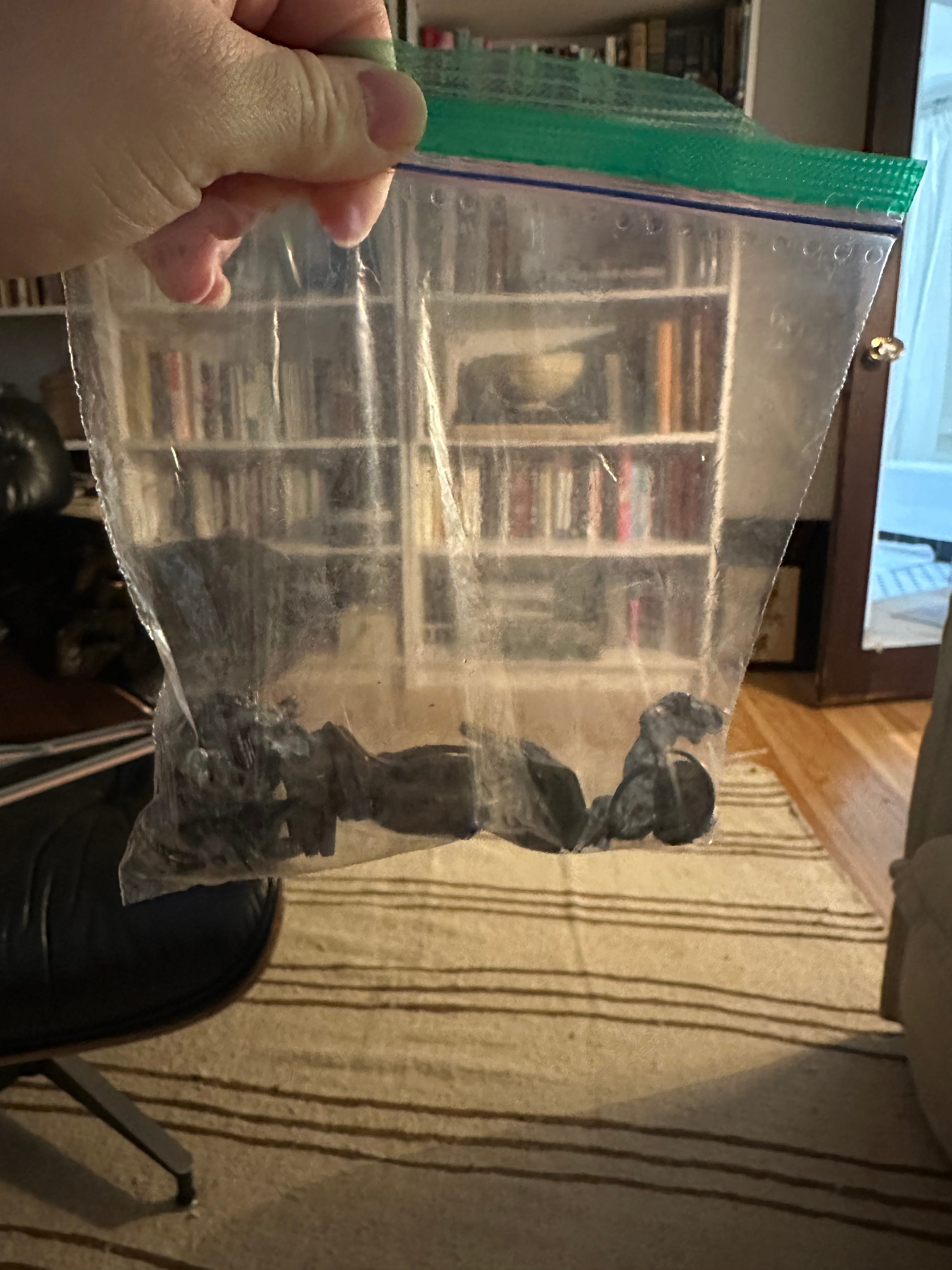
The firefighters work in the hot sun, faces caked by sweat and plaster dust, sifting through the rubble. And goddamn if they don’t find things—Lo’s grandma Esther’s ring. The watch her parents gave her for college graduation. A pair of Deco earrings I bought her for our anniversary. A hunk of melted silver.
I’m excited to call Lo, to claim this small victory—something clawed back, however minute.
Forty-five minutes in, I notice that Leo and Charlene’s cars are still parked in their driveway. I want to believe a relative must have picked them up. But I also share my worst fears with the fire crew and point out where their bedroom used to be.
As the crew gets ready to investigate, I ask if I can stay a little longer.
Captain Jill shrugs: “It’s your house.”
🔥🔥🔥
Standing in the backyard, I suddenly feel exhausted. I retrieve a cushion blown into Leo’s yard, drop it on a chaise lounge, and collapse into it.
In 2022, an undiagnosed ectopic pregnancy ruptured, and Lo nearly died. The day she came home from the hospital, my mother-in-law showed up with a moving truck, three movers, twelve chaise lounges, and eight 300-pound Grecian olive pots. The scale of the gift—grand, impractical—was, I think, a reflection of helplessness, a desperate need to do something.
The olive pots lay on their sides for three years, rounded sarcophagi with a fuzz of green moss. We once joked that they’d stump future archaeologists; now they look, in situ, like some Minoan ruin.
For a small pool-less backyard, the chaise loungers were ridiculous, aspirational—and perfect. We used them every day: coffee and crosswords, lounging with the dogs, backgammon by the fire pit, breakfast in bathrobes. I’d take an edible and squint up into the leaves of the giant Black Walnut tree—a contained ecosystem of squirrels, green macaws, black crows, even hummingbirds. We had arranged the loungers in a horseshoe around the yard, four, four, and four. You could move clockwise from one to the next, staying perpetually shaded as the sun circled the sky.
Lo and I sat there the day after Jynx died. It was early spring. I told her we’d see a lot of life in the backyard. I meant the bluebirds I could see weaving a nest over her shoulder.
A week later, she screamed from the Rumpus Room bathroom—she was pregnant.
I lie back, close my eyes, and breathe in toxic bits of our transmogrified home.
🔥🔥🔥
You start to organize what you’ve lost. The valuable. The sentimental. The truly irreplaceable.
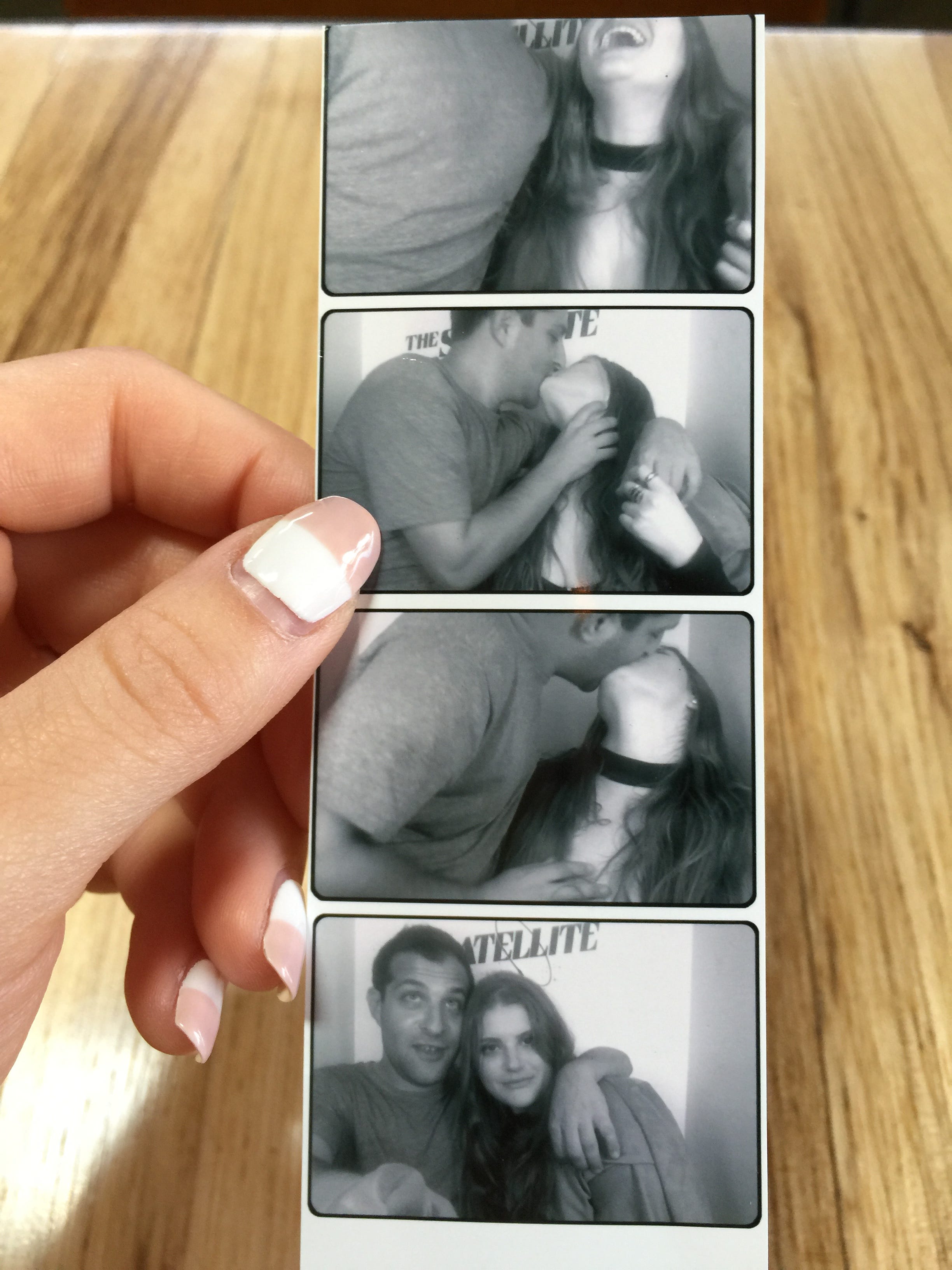
Photo Booth strips are played-out, but so what? By the time we got to the Silver Lake Lounge many hours into our first date, I was half in the bag and mostly in love. Usually, you get four mugshots in slow collapse. Frame one: your practiced, bathroom-mirror smile. Frame two: the confused “should there be a flash?” look. Frames three and four: some failed stab at spontaneity. But ours looked like the night felt—slippery, stupid joy. The absurd, electric discovery that you’re smack in the middle of your life changing forever.
Pictures 1-4: kiss, kiss, kiss, semi-blackout. Lo’s laughing, her eyes closed, her eyeliner smudged. My hands are in her hair.
I embarrass easily. It embarrassed me that Lo kept them on the fridge, curled like an old receipt, their ink a little faded—like the paper was blushing. I’m embarrassed now, describing them. But they were both time capsule and premonition—slightly out of focus, startlingly tender, caught just in time—and I wish we still had them.
🔥🔥🔥
Friday night, we sit shiva for the house. Friends who had announced they could only stay an hour linger past midnight. David brings wine. Max orders pizza. Phoebe—the first person I told we were pregnant—cradles Felix and pretends not to notice as others circle, bemused, angling for their turn with the baby. Sarina, wielding the decisive efficiency that made her an Emmy-winning producer, takes one look at the piles of donations and immediately gets to work—sorting, laundering, editorializing—helping Lo decide what to pack and what to re-donate. At one point, I tell Sarina I feel bad sitting on the couch while she does all the work. 'You could help,' she says. Bluff called, I pour myself a fourth glass of wine.
Time undulates, a lazy ripple across a still pond. The pleasure is in the ease of the company, the sweet sadness of an unspoken farewell. We might return, but a chapter is closing. The city will survive and evolve, but it won’t reclaim everything it lost. As the great man wrote: We sat there long into the night, the bottle diminishing, our voices growing louder, our wit quicker, our laughter easier. It felt like we were all remembering something together, even if no one could say exactly what.
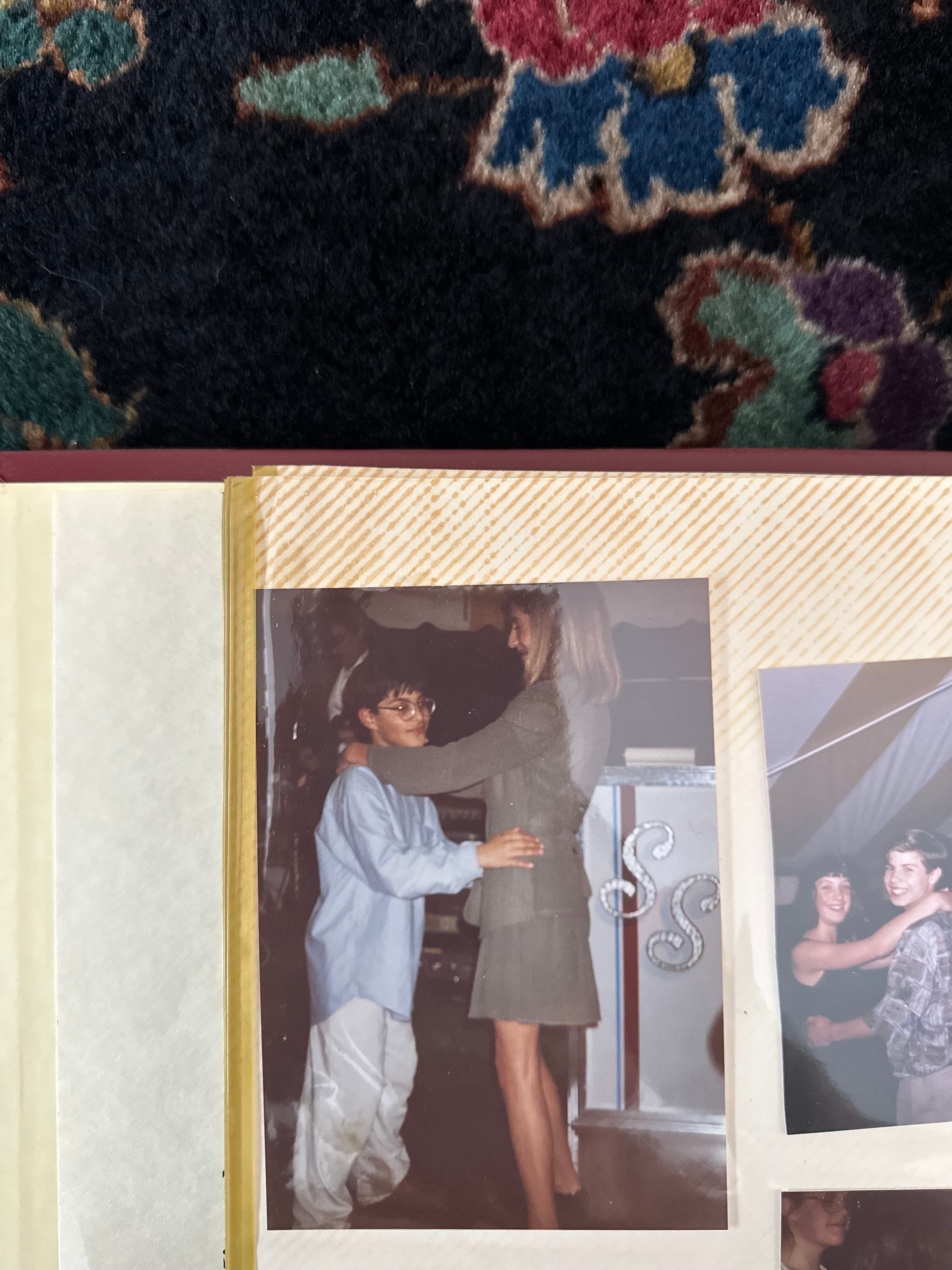
I suspect I’m not alone in recalling 7th grade more clearly than, say, college or my late 20s. I was sad and short, desperate for inclusion but unbearably off-putting. Shame sears itself into memory like a scar; contentment blurs and blends. I hold Felix, warm with good talk and cheap wine, and think about Junior High Jordy—how gladly he would have traded a house full of stuff for this room full of friends.
Me dancing at my Bar Mitzvah
🔥🔥🔥
The night before we fly East, my in-laws bring dinner. I sit with my father-in-law, exchanging the smallest of small talk, hollow pleasantries that keep unwanted thoughts at bay. Annette and Dani help Lo pack.
Lo has spent the week multitasking as she mourns. She opened an insurance claim, scheduling her crying jags for the interminable stretches on call waiting. While I took the dog for long walks in the smog, she priced flights, tapped New York family for winter gear, and consulted pediatricians about flying with an unvaccinated newborn.
But now, each packing decision—Sleepytime Baby Lounger or Moses basket? Baby books or baby boots?—feels pressed by unspoken questions (When will we be back? Will we be back?). Lo comes undone. What we’ve lost is behind us. Ahead: the vast unknown, starting with a panic-attack of a travel day. Lo sits on the floor, stuck in liminal space, and cries. The baby, an energy sponge, launches into his Category 5 wail—max-decibel, face-mottled, choking. I take him into Sophie’s bedroom, turn off the lights, and we rock back and forth in the pitch black, shhh shhh shhh-ing.
Annette, my mother-in-law, is a Pied Piper of children. I’ve been at family holidays where Annette disappears for hours—off building couch forts with seven-year-olds, or dressed as a matching pink princess with my niece. If anyone was more excited by Felix’s arrival than we were, it was Annette. He was her bambino, her principe. A fist in his mouth? A mark of genius. A head swivel at three weeks? Proof of his future athleticism. She’d scoop him up and lead him on a grand tour of our small house like a realtor with her most important client. This is the Great Room. This is the Primary Bathroom. This is chiaroscuro. This is a Minnotti, a very important furniture designer.
I’ve been alone in the dark bedroom for nearly an hour when the door opens. It’s Annette. I’ve never seen Annette in a T-shirt or without makeup. I’ve certainly never seen her cry. That’s when I really understand: she thinks we’ll be gone for a long, long time.
We separate, and she smooths her hair, gathers herself. She reminds me that Lo—like Annette—has 'little bitty arteries and veins and gets cold very easily.' I promise to keep Lo warm in Connecticut.
🔥🔥🔥
The Palisades Fire incinerates 6,000 homes. Firefighters call for reinforcements that never arrive. The area reservoir is offline for maintenance. Hydrants run dry. As a last resort, firefighters fill buckets with chlorinated pool water. My brother-in-law’s childhood home burns. Every possession that belonged to—and evoked—his late mother is lost. Mark and Claire, newly married, lose their house before finalizing their insurance policy; Phoebe’s store survives, but sprinklers ruin the merchandise. Her customers are displaced.
The Eaton Canyon fire is, if anything, more infuriating. The Palisades fire was likely sparked by drunk teens; Altadena was doomed by mendacious negligence. At first, SoCal Edison claims no record of an electrical failure on its Altadena lines. Then, New York Times reporting unearths CCTV footage suggesting the fire started at their transmission towers. Whisker Labs, a Maryland tech firm, detects two massive transmission faults—so strong they trip sensors in Portland and Salt Lake City.
Did SoCal Edison stick to its story? Well, first, in a totally-not-suspicious move, Edison rebuffs efforts to preserve the data, claiming ignorance of any evidence linking their lines to the fire. Summarily rejected by a judge, the good folks at SoCal Edison check their records again.
Actual quote from SCE’s Pedro J. Pizarro: 'We went back and said, ‘Hey, are there things we just don’t understand here?’"
A mystery for the fucking ages! Things we just don’t understand! Transmission faults so strong they trip sensors in Portland.
Mr. Pizarro says the threshold for cutting power to transmission lines is high; 100 mph winds notwithstanding, Edison had no indication such an action was warranted. As the fire spread, firefighters pleaded for a shutdown. Edison said they were “short on manpower,” and the firefighters should treat “everything as live.”
Our mayor—who literally ran on not traveling abroad—was at a cocktail party in Ghana when the fires started. Her opponent in the mayoral election—self-anointed 'common sense' warrior and champion of the landed gentry, Rick Caruso—spends hours on TV criticizing her leadership, then sends his tenants a letter: rent recommences in 60 days.
In 2019, our governor championed legislation shielding utilities from wildfire liability.
The worst people flood the zone with bullshit. Elon Musk blames 'LAFD underfunding.' LA Times publisher Patrick Soon-Shiong criticizes the fire department budget with debunked figures. Trump blames endangered fish. 'They just can’t put out the fires,' he posts on Truth Social. 'What’s wrong with them?'
They bicker while L.A. burns.
🔥🔥🔥
The word people use most often when they hear about the house is unimaginable. It bothers Lo. She is an empath Olympian—tell her a story, and she feels it. So when people say our experience is unimaginable, she has to stop herself from saying, “But try.”
To be fair, I lived through it, and even I find I have to imagine it. We lost a house, not a parent. A neighborhood, not our lives. Everything most important, we kept… then why this rending grief, the wild confusion, the fever-dream sensation of endlessly plummeting down, down, down?
The Eaton Fire knocks us into a parallel timeline. In 9,999 of 10,000 simulations, we’re loading Felix into the stroller, hosting Seder, watching the bluebirds repair their spring nests. But in this cursed branch of the multiverse, we have no home, and my wife, my son, and I live down the hall from my parents. In the mornings, giving Felix his 5 a.m. bottle, I hear their clock radio play Morning Edition. Instead of my whatever graphic tee with whichever pair of jeans, I wear clothes donated by friends of friends—charity from strangers. It’s all nice stuff I might admire but would never buy: Vince, James Perse, and Theory, in navy, black, and black-ish navy. Before the fire, I looked like a screenwriter; now, I dress like Kendell Roy when he tries to pass as merely rich. Annette hasn’t seen her bambino in months. Aunt Dani was going to babysit every week: now, we Facetime when we can. Instead of spring in Altadena, we have March in Connecticut. When the temperature drops below 30, the frozen ground numbs Salem’s paws, and she falls onto one side, staring up at us, befuddled. It’s little things, but it’s thousands of them. It’s all of the discrete choices and people and environments that make up the chosen version of our life.
And—this goes nearly without saying—we feel incredibly lucky. If you lived in Janes Village or the Highlands of the Palisades, ours is a best case scenario: upheaval and anxiety instead of community and stability. In place of a future, an aftermath.
People who should be alive are dead. A retired aerospace engineer, 82, is found in his front yard, garden hose in hand. An actress, 95, who played in Lady Sings the Blues, The Ten Commandments, and The Blues Brothers; she owned a blue Cadillac she’d vowed to restore. A costume shop forewoman at LACC, expert in period dress, who bought books, gave them away, then bought more to fill the shelves. These people raised kids in Altadena, watched grandchildren grow, celebrated anniversaries and holidays. We don’t know if Leo and Charlene got out.
To grieve, you have to know what was stolen. You have to rue.
✈️✈️✈️
On the day we fly to New York, I wake to the news that David Lynch has died. He must have spent his final week listening to those incredible Santa Anas; I hope he had a chance to put his face in the wind.
At the airport, all is chaos. Felix is strapped to Lo’s chest, the dog in a carrier on her back. I look like a one-man band, baby gear and bags hanging from every limb, as I nudge a precariously balanced luggage cart forward with my forehead. Each stroller and bassinet component counts as a separate piece of luggage and the fees total nearly $1000.
“Our house burned in the fires,” Lo offers.
The gate agent squints. “Are you firefighters?”
“No. We lived in Altadena.”
The agents huddle, whisper. A decision is made. “I’m sorry, we don’t have a policy that covers living in Altadena.”
✈️✈️✈️
At TSA, the stroller triggers an alarm.
“Can you step over here, sir?” I’m informed they’ll need to go through all of our bags; dog and baby will have to come out of their respective carriers. A gloved hand will pat me down from head to toe. The back of that glove will lift my balls and spread my cheeks.
“Please,” says Lo. “Our house just burned down.”
An agent reaches into the diaper bag, pulls out the thermos, and shakes it curiously; twelve ounces of cold breast milk spill onto the terminal floor.
“What if,” I ask, “I told you we weirefighters?”
✈️✈️✈️
On the flight, the baby is an angel.
I watch Twin Peaks: Fire Walk with Me on the flight. Savaged upon release, the Twin Peaks prequel is a masterpiece that fundamentally reframes the original series. In the show, Twin Peaks’ folksy townspeople seem able to resist the evil lurking in the woods. Warmth, love, community—they keep darkness at bay. Fire Walk with Me reimagines a balanced battle between good and evil as an unrelenting, intimate nightmare. The horror isn’t just in the woods—it’s in the home, in the very spaces that should provide safety. Laura Palmer suffers in plain sight while the town looks the other way.
And, I realize, I’ve also gotten wind totally wrong. Lynch doesn’t use wind to signal the mystical. The whispering wind signals the presence of the malevolent Black Lodge. Teresa Banks’ body floats down Wind River; a gust of wind muffles Laura’s final scream. Wind is raw power—occasionally harnessed, never controlled.
Wind — and, I mean, it’s right there in the freaking promotional materials — is fire:
❄️❄️❄️
At JFK, Lo takes Felix into the women’s room to change him into the snowsuit my parents overnighted to us in Silver Lake. We step out of the terminal into the coldest night of the year.
Thanks for reading! Subscribe for free to receive new posts and support my work.
Your powers of description are simply amazing. What a talent you have. I know you lost a huge amount as a family materially but I admire you for your strength and love for each other. One day your little boy will read this and be proud. There are so many awful things happening in the world today but I am both happy and inspired that there are people like you and Lo in it. Well done!



Your powers of description are simply amazing. What a talent you have. I know you lost a huge amount as a family materially but I admire you for your strength and love for each other. One day your little boy will read this and be proud. There are so many awful things happening in the world today but I am both happy and inspired that there are people like you and Lo in it. Well done!
so beautifully recapped, and something felix will treasure reading one day 🩷